Imagine you and your friend are finally enjoying a long-awaited powder day in the backcountry when it suddenly takes a detrimental turn. Snow begins to swallow you and you are no longer in control, thrust into a blur of white.
Opening your eyes is overwhelming at first. Blurry bright lights come into focus with a few blinks. Then, reality sets in. You are in a hospital room and your friend is sitting next to you.
He explains that you were caught in an avalanche, sustaining a broken femur, fractured pelvis, blown knee, lacerated liver, and a punctured lung. He found you partially buried, head out, and barely breathing. Heart racing, he had checked his phone—no service.
Taking a moment to evaluate the options, it clicks—the community radio channel. He knew if someone else was tuned in, perhaps they’d have service and be able to call 911.
His voice a little shaky, he recalled to you how he pulled out his radio, adjusted it accordingly and asked if anyone could hear him and had service to call 911. After a few eternal seconds, a voice responded, overlayed with static but decipherable. Then, another voice came through.
Locals monitoring this channel included a physician, members of a ski patrol, and a veteran mountain guide. They were able to call 911, mobilize a helicopter evacuation and rush to the scene to help. The community channel via two-way radios resulted in the quick response time that saved your life.
This scenario is based on one of many incidents in Telluride Colo. where the backcountry radio channel program saved a life. These programs establish dedicated radio channels for popular backcountry ski zones and are a vital resource coming to the Tahoe region this winter.
Although not a replacement for calling 911, the channels can allow skiers to send a distress call for help or request another group to call 911 if out of service, as exemplified above. This can all reduce the time from injury to rescue response, which can be critical for life threatening injuries.
Expanding a lifesaving resource
First developed and deployed in Telluride around 2016, the lifesaving resource has spread to Snoqualmie Pass Wash., and Wasatch, Utah within the last decade.
Modelling these programs, Tahoe Backcountry Ski Patrol (TBSP) coordinated the launch of the vital resource here in Tahoe.
Over the past year, TBSP has engaged with the Tahoe community and stakeholders, conducting surveys and meetings. The engagement was crucial in developing the program and defining the region’s zones.
The working group received insight from Matt Steen, the inventor of the community radio concept in Telluride and Justin Davis, who launched the program in Snoqualmie Pass.
“They were both impressed with the scope of community radio in Tahoe,” Jamie Morgan said, radio project lead for TBSP. With 60 miles of Sierra Crest, over 40 trailheads and over 20 zones, the project is no small undertaking.

TBSP picked the trailheads based on popularity and drew the 3-5 miles zones based on community input, location on public lands, and used natural features as boundaries. Organizers then assigned each zone its channel and privacy code.
The zones have easy to remember geographical names such as Rubicon, Scott Peak, and Luther Pass South or North.
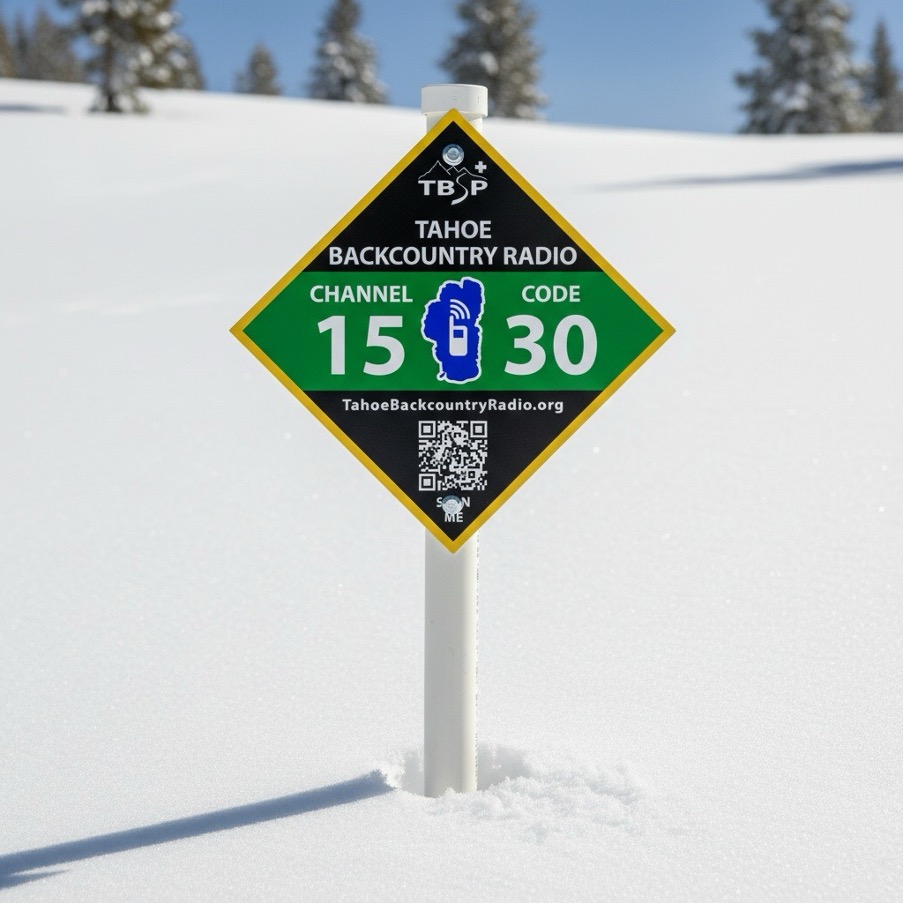
Signs at the trailheads provide the zone’s specific channel and code, as well as a QR code for more information. Backcountry huts will also include the signs.
Dedicated volunteer trail stewards install, monitor and maintain the signs throughout the season, while advocating for the program on the trail. Gathering information on usage, the stewards will also collect valuable data to help refine the program.
Everyday safety enhancing features
In additional calling for help, the channels also have practical everyday uses that contribute to an overall safer backcountry by expanding communication. At the start, channel users will communicate their presence on the channel to build awareness and affirm that there are other people out there.
Skiers within the zone can alert anyone else in the zone to potential hazards.
- Example: “We see a weak layer CT9 down 10 cm on Jake’s north trees at 8,000.'”
Channel users can also alert other skiers and riders when entering complex terrain.
- Example: “We are about to enter Emerald Chute, is anyone below?”
Finally, channel users can let others know when they’ve cleared a line or area.
- Example: “We are clear of Eagle Chute. We observed a sluff on skier’s right halfway down.”
To ensure the zone channels do not have too much traffic, people are to announce that it is a community channel and suggest that the people use an adjacent channel if chatter becomes an issue.
Finding zone information
Interactive online zone maps are available at Tbradio.org/map. In addition to zone names and boundaries, the map also provides trailhead names and locations, as well as helpful overlays such as slope angle shading, and real time avalanche observations.
For more information on the Tahoe Back Country Radio Program or to volunteer, visit, tahoebackcountryradio.org.
Editor’s note: This article originally appeared in the Winter 2025/26 edition of Tahoe Magazine.