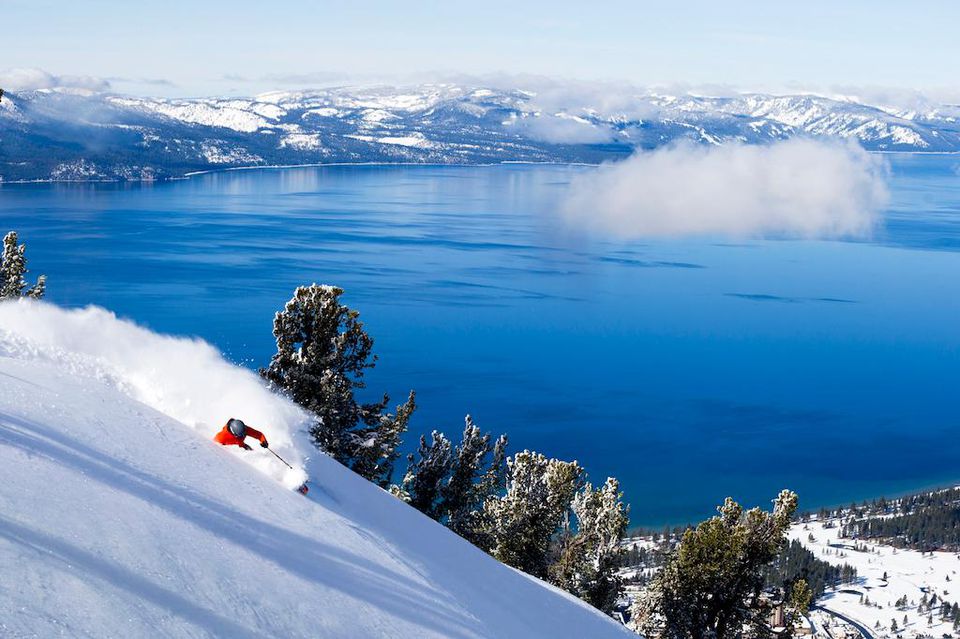
SOUTH LAKE TAHOE, Calif. – Lake Tahoe locals packed Lake Tahoe Community College’s Duke Theatre on Tuesday to hear how modern mountain weather forecasting works and how artificial intelligence is shaping its future.
The event, part of LTCC’s Speaker Series and organized in collaboration with Operation Sierra Storm, featured OpenSnow forecaster Bryan Allegretto and AI engineer Andrew Brady. The seminar drew students, faculty and community members interested in meteorology, data science and the real-world impacts of weather in the Tahoe Basin.
By the time the program began, most seats were filled.
Allegretto, known to many Tahoe locals simply as “BA,” opened the presentation by sharing how OpenSnow began not as a tech company, but as a personal effort to make mountain forecasts more honest and more useful.
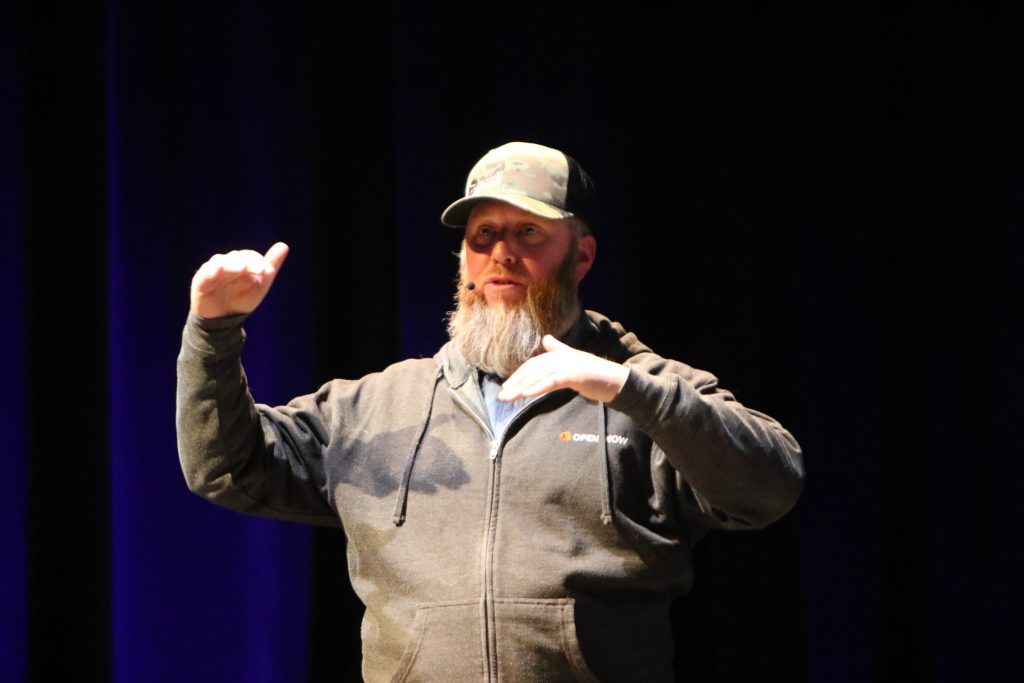
Allegretto has been forecasting Sierra Nevada winter storms for two decades and has built a reputation as one of the Tahoe region’s go-to weather experts. After growing up chasing storms and graduating from college, he brought that passion west and moved to Tahoe in 2006 to work in the ski industry.
Frustrated by how unreliable traditional forecasts often were in complex mountain terrain, he began creating localized storm reports for Tahoe ski areas. Those early forecasts were emailed to friends, then published online. In 2011, he teamed up with fellow forecaster Joel Gratz to formally launch OpenSnow.
“When storms hit mountains, everything changes,” Allegretto said. “You can have rain at the base, blizzard conditions at the summit, and lift-closing winds in between.”
Allegretto emphasized that OpenSnow was built around a core philosophy he and Gratz established early on.
“That was always Joel and my mission with this company, to do not only the hard way of working for free, but the hard way of building a company based on telling skiers what’s actually going to happen, even if it’s bad,” Allegretto said.
He told the audience that accuracy and transparency have always taken priority over hype, even when forecasts aren’t what people want to hear.
Today, OpenSnow employs a team of 13 forecasters living in mountain regions across the United States, each specializing in their local terrain and storm patterns. Their work centers on correcting errors in large-scale weather models and translating them into highly localized mountain forecasts.
Allegretto explained how steep elevation changes, wind exposure and rapidly shifting snow levels make mountain forecasting far more complex than flatland forecasting. A single storm can bring rain, snow and extreme winds to different parts of the same resort at the same time.
OpenSnow spent years developing internal systems that blend multiple forecast models, correct long-standing biases and downscale them to GPS-specific locations. Users can click nearly anywhere on a map to view forecasts for snowfall, wind, temperature and snow levels.
He also described the company’s snowfall estimation technology, which uses high-resolution models to calculate how much snow has fallen in areas without physical sensors, a significant advantage in wind-affected mountain environments.
Brady followed with a presentation on how artificial intelligence is accelerating forecasting advances.
Instead of relying solely on traditional physics-based models, Brady said AI systems are trained on decades of historical weather data, allowing them to recognize atmospheric patterns and how terrain reshapes storms.
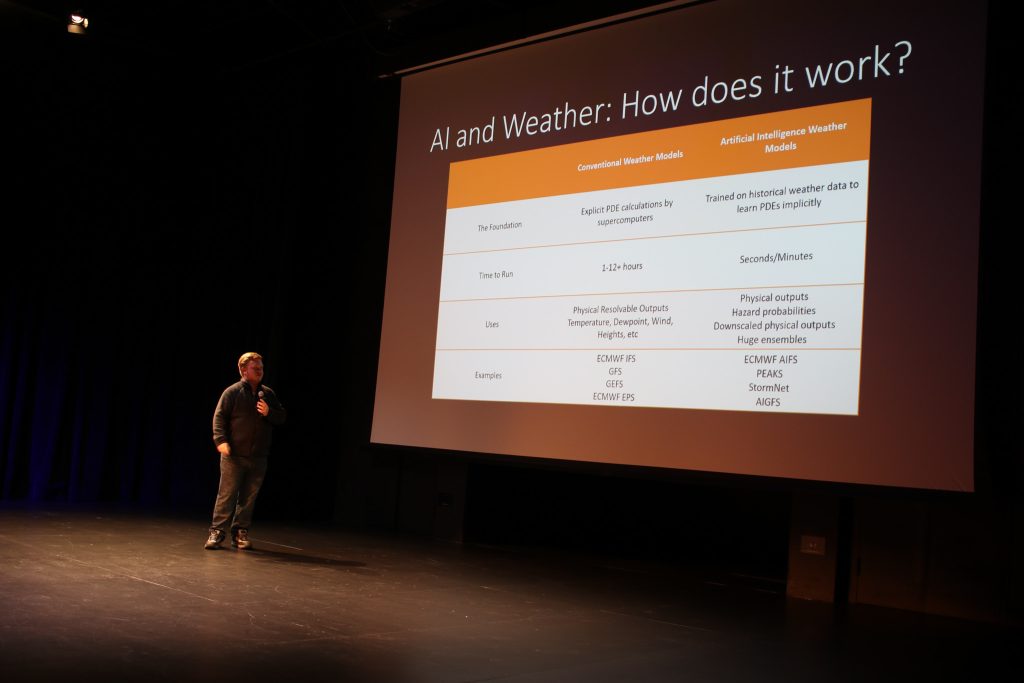
OpenSnow recently launched its in-house AI downscaling system, known as “PEAKS,” which converts large-scale global models into high-resolution, mountain-specific forecasts extending up to 15 days into the future.
“This allows us to better represent valleys, ridgelines and elevation effects instead of averaging them together,” Brady said.
Brady also highlighted StormNet, OpenSnow’s severe-weather AI platform that predicts lightning, damaging winds, hail and tornado potential. StormNet updates every two minutes and is already being used by broadcasters and emergency agencies in parts of the country. The technology is now integrated into OpenSnow’s real-time radar and alert systems.
Looking ahead, Brady previewed upcoming projects, including a snow-quality forecasting tool designed to estimate how ski conditions are evolving, and an AI-assisted avalanche forecasting system aimed at extending danger predictions several days into the future.
The strong turnout underscored how closely weather is tied to life in the Tahoe Basin, from recreation and transportation to water resources and public safety.
The seminar offered attendees a behind-the-scenes look at how the forecasts they rely on daily are created and how emerging technology is set to make them more precise, more local and potentially more life-saving.
To learn more visit opensnow.com.