
Despite President Donald Trump’s repeated rejection of Project 2025 while campaigning, one year into his second administration, the federal government has fully or partially implemented over 80% of the public land actions contemplated by the conservative roadmap.
This is according to a new report from the Center for Western Priorities, a left-leaning conservation and advocacy organization and think tank based in Colorado. The report evaluates 70 directives from Project 2025 that were related to public lands and identifies whether the administration has made any progress toward achieving each.
It concluded that 50% of the directives have been fully completed, 34.3% are in progress, and 15.7% have not been attempted.
Project 2025 is a conservative playbook written in 2022 ahead of Trump’s election and inauguration for a 2025 Republican presidency. The over 900-page “Mandate for Leadership” was produced by The Heritage Foundation, a right-leaning think tank based in Washington, D.C., with over 30 authors and over 300 contributors.
Trump publicly disavowed the roadmap several times during his campaign. During a Sept. 10, 2024, debate with former Vice President Kamala Harris, Trump said, “I have nothing to do with Project 2025,” going on to claim that he had purposefully not read it and had no plans to ever read it.
“The speed with which President Trump has embraced a plan he once claimed to know nothing about is staggering,” said Kate Groetzinger, communication manager at the Center for Western Priorities and a lead contributor on the report, in a statement. “By gutting federal agencies, fast-tracking logging, and locking in long-term drilling leases, the Trump administration is effectively turning our national public lands into sacrifice zones for private profit.”
What Project 2025 said about public lands
When it comes to public lands, Project 2025 laid out actions that would rollback and rescind many Biden-era policies and rules around endangered species and climate action, increase domestic energy production (with special attention paid to Alaska), logging and other development activities on public lands, as well as reform federal statutes like the National Environmental Protection Act, or NEPA, and the Endangered Species Act.

The majority of the public land items pertain to the Department of the Interior and its subagencies, including the Bureau of Land Management, the U.S. Forest Service, the National Park Service and U.S. Fish and Wildlife Service. William Perry Pendley, an attorney who led the Bureau of Land Management during the first Trump administration, wrote the Project 2025 Interior Department recommendations.
Under Biden, Pendley claimed that the Interior Department was “at war” with its mission, including its “obligation to develop the vast oil and gas and coal resources for which it is responsible” as well as its mandate to manage Bureau of Land Management lands with multiple-use and sustained-yield principles.
“Instead, Biden’s DOI believes most BLM land should be placed off-limits to all economic and most recreational uses,” Pendley wrote.
A few of the public land directives also fell under the roadmap’s recommendations for the Environmental Protection Agency and the Council on Environmental Quality, which was established to oversee federal agencies’ implementation of NEPA.
The Environmental Protection Agency section of the roadmap was written by Mandy M. Gunasekara, an attorney who led the agency during the first administration. Project 2025’s Council on Environmental Quality recommendations were included in those for the president’s executive office, which was written by Russ Vought, a political advisor who is now serving as director of the Office of Management and Budget.
What the Trump administration has completed from the roadmap
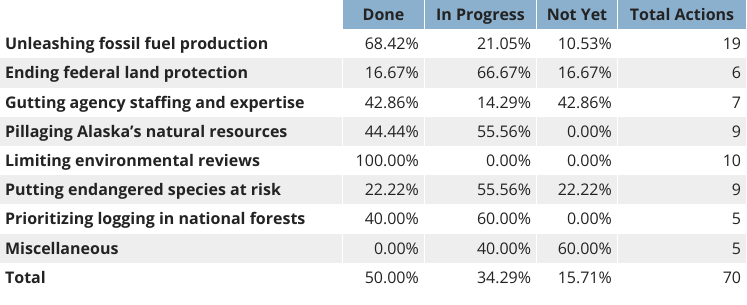
The Western Priorities’ report split its analysis of the actions in Project 2025 into several categories pertaining to fossil fuel production, federal land protections, agency staffing and expertise, Alaska’s natural resources, environmental reviews, endangered species, logging on national forests and miscellaneous actions.
The findings are “a warning to those who care about public lands: opposing the sale of public lands is not enough — if the Trump administration and Heritage Foundation have their way, our public lands will be effectively privatized by the end of Trump’s presidency in 2028,” Groetzinger stated.
“This will be achieved through the gutting of federal agencies, the issuance of long-term logging and drilling leases, and the permanent destruction of habitat by the proliferation of clear cuts, well pads, and mines,” she added.
The recommendations surrounding environmental review under NEPA and those to increase fossil fuel production have been the most widely implemented.
“All 10 of the actions related to limiting environmental reviews recommended in Project 2025 identified by our team have been completed or attempted by the Trump administration,” the report states.
This has included Interior Department Secretarial Orders to streamline NEPA reviews and expedite permitting as well as the rescinding of the Council on Environmental Quality’s regulations for NEPA.
The report concluded that nearly 70% of Project 2025’s recommendations related to fossil fuels have been completed, and 20% are in progress. Western Priorities identifies that “in progress” refers to orders made or the initiation of a rulemaking process to implement the action, but the rule is not finalized.
The administration’s actions to increase fossil fuel production started on day one of Trump’s second term with an executive order promising to “unleash” domestic energy. This was followed by an Interior Department Secretarial order in February, which rescinded many Biden-era climate efforts and eliminated “undue burdens” on domestic energy. These orders and subsequent actions achieved Project 2025’s recommendations around ending the coal leasing moratorium, re-opening energy leasing in the Atlantic, Pacific and Arctic areas, re-prioritizing quarterly lease sales on BLM land and more.
The passage of Republicans’ “One Big Beautiful Bill Act” in 2025 advanced additional energy production efforts, including mandating rolling lease sales and reducing royalty rates for oil and gas companies.
So far, the actions surrounding federal land protections have been the least implemented. The report found that less than 20% of the roadmap’s recommendations around land protections — such as those granted to national monuments —have been completed. However, nearly 70% are in progress.
Trump’s day-one order to rescind the Biden-era 30 by 30 conservation goal achieved or moved toward several of the roadmap’s recommendations, including attempts to rescind the BLM Public Lands Rule and the Roadless Rule, and to divert funds for the Land and Water Conservation Fund. The U.S. Department of Justice also released a legal opinion in June that sets the administration up to rescind some of the national monuments created by past presidents, contradicting how the department has interpreted the Antiquities Act for 87 years.
Similarly, Western Priorities reported that 20% of the nine actions about endangered species have been completed, but 55% are in progress.
This includes species-specific actions around grizzly bears and gray wolves. Project 2025 recommended that both species be delisted from the Endangered Species Act. While bills to delist these species are moving separately through Congress — including a bill from Rep. Lauren Boebert, CO-4, about gray wolves— the U.S. Fish and Wildlife Service has also taken steps that move Project 2025’s goals forward, the report claims.
In November, the Fish and Wildlife Service also announced four proposed rule changes that will impact the Endangered Species Act, two of which align with Project 2025’s recommendations “to change how critical habitat is designated and what criteria must be considered when evaluating areas to exclude from critical habitat,” the report states.
According to the report, some of the actions that the administration has “not yet” attempted include:
- Moving the Bureau of Land Management headquarters back to the West — Rep. Jeff Hurd, CO-3, has introduced legislation to move it back to Grand Junction
- Repealing the Antiquities Act
- Increasing transparency and data around Endangered Species Act decisions
- Reducing the number of field coal reclamation inspectors
While the Trump administration has brought many changes to public land management and protection, the report notes that Western constituents have drawn a clear line surrounding public land sales, as evidenced by the June proposal from Sen. Mike Lee, R-Utah, to sell up to 3 million acres of public land during the reconciliation process. The proposal was ultimately defeated, after opposition to any sales came from a broad, bipartisan spectrum of interests.
“President Trump will undoubtedly continue to implement Project 2025 as he enters the second year of his second term,” the report concludes. “Westerners will, in turn, continue to rise up and defend the existence of public land.”