
RENO, Nev. — Spring has already arrived in Nevada, and with several days of temperatures reaching into the high 80s in some areas, the Nevada Department of Wildlife (NDOW) is reminding residents that bears are already out of their dens.
With snowpack still in the mountains, many bears will likely move down into lower elevations as they emerge, often following creeks to the fresh green grasses as they search for natural food sources. As they travel, neighborhoods are often some of the first places they pass through.
Now is a good time to take a look around your home and make sure a bear will not see your property as a food source. A few simple steps can make a big difference in preventing conflicts and keeping bears wild.
Start with garbage
About 90% of bear calls are related to unsecured trash. Securing and making garbage containers bear-resistant is the single-most effective thing you can do to prevent bears from viewing your home as a rewarding place with a free high-calorie meal.
Waste Management and Douglas Disposal offer bear-resistant garbage cans that can be left out. Residents can request one by calling (775) 329-8822, (775) 343-7596 for Carson City, or (775) 782-5713 for Douglas Disposal. In the meantime, store non-bear-resistant garbage cans in a locked metal shed or garage and only put them out the morning of trash pickup.
Washoe County, Carson City and Douglas County have garbage ordinances that require residents to secure their trash to prevent bears from accessing it. Failure to do so can result in fines.
Repeated violations can be reported to local code enforcement at (775) 328-6101 for Washoe County, (775) 887-2599 for Carson City and (775) 782-6214 for Douglas County.
Other attractants to remove
Remove bird feeders when bears are active. For other ways to attract birds to your yard without
attracting bears, visit: Remove birdfeeders – birdfeeders, seed can become bear feeders
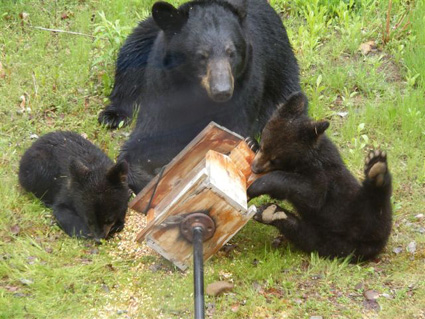
Pick fruit as soon as it is ripe and clean up fallen fruit from the ground. Electric fencing can be a
good option around fruit trees if installed wide enough so fallen fruit lands inside the fenced
area.
Remove other attractants from your yard, including pet food, dirty barbecues, trash and any
other food or scented items.
Install electric fencing around beehives, gardens, chicken coops or livestock. For more
information, visit: BearWise Bulletin: Electric fences keep bears out
As a precaution, remove food, trash and other scented items from vehicles. Keep windows up and doors locked when not in use.
Cub vs. yearling: What is the difference?
Residents may start to see young bears this time of year, and it is important to know the difference between cubs and yearlings.
Cubs are very small and are usually born in January or February while the female is denning. By spring, cubs are still small and stay very close to their mother. If you see a cub, the mother bear is very likely nearby, even if you cannot see her.
Yearlings are bears roughly 1 year old. They are larger than cubs, often similar to a medium- sized dog, and may sometimes be seen on their own. Yearlings are still learning natural behaviors and exploring new areas as they begin to spend more time on their own, which can sometimes bring them into neighborhoods as they search for food. If you see a cub or a yearling, give it plenty of space, secure attractants and never approach or feed a bear.
If you see a bear
If you see a bear near your home, haze it from a safe distance. From an open window or other safe location, yell loudly and bang pots and pans. Yelling things like “Hey bear,” “Go bear” or “Get out of here bear” alerts those around you to what is happening and helps reinforce that bears are not welcome in neighborhoods. You can also trigger your car alarm to scare them off. These actions help negatively condition bears so they learn to avoid people and homes.
Learn more or report a bear
For more information, visit https://www.ndow.org/blog/living-with-bears/ or BearWise® at https://bearwise.org/bear-safety-tips/keep-bears-out/ for more tips. To report bear incidents, call 775-688-BEAR (2327).