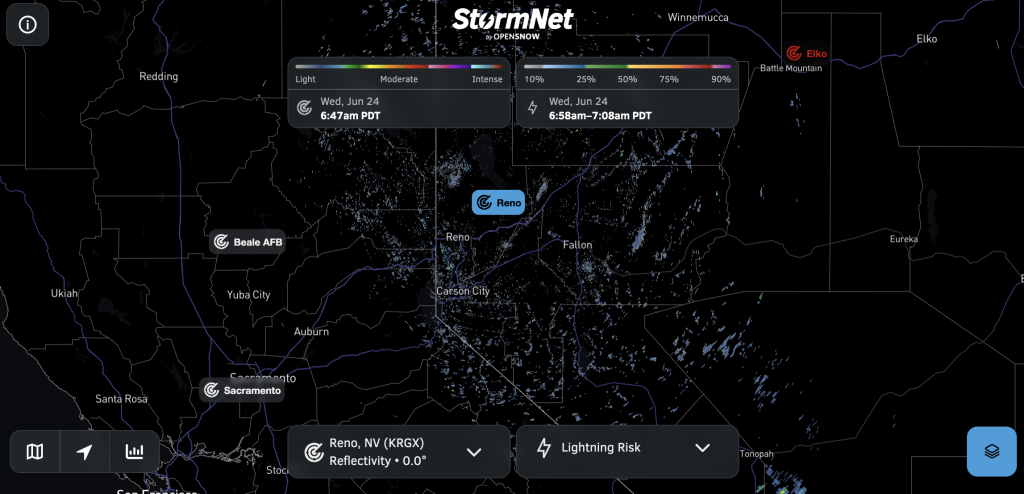
BOULDER, Colo. – StormNet, the free app offering real-time severe weather forecasting powered by OpenSnow, outperformed seven competing forecasting models to take the top spot in NOAA’s Hazardous Weather Testbed Experimental Forecast Program Spring Forecasting Experiment. During the blind experiment, conducted in April and May 2026, StormNet ranked first across all lead times and during each week of the experiment, resulting in a first-place overall ranking at the conclusion of the test.
The Spring Forecasting Experiment, an annual, multi-week initiative co-led by the National Severe Storms Laboratory and the Storm Prediction Center, evaluates experimental models and radar technologies to improve the lead time and accuracy of tornado, hail, and flash flood warnings. Throughout the experiment, StormNet’s technology consistently bested that of heavyweights including Google DeepMind, the National Center for Atmospheric Research (NCAR), the University of Oklahoma, and others.
“At the end of the experiment, facilitators asked to use StormNet in their forecasting to test how well it does through the rest of the summer,” said Andrew Brady, StormNet founder and OpenSnow engineer. “We’re proud of how our technology stacked up against the competition, and are pleased to offer it as a free app download for everyday users who might find it useful when planning travel or activities based on the severe weather risk.”
Using machine learning and AI, StormNet analyzes radar and 125 million weather data points to produce cohesive severe weather forecasts every two minutes that look out up to 14 days in the future. With the ability to identify everything from lightning and damaging winds, to large hail and tornadoes, StormNet offers first-of-its-kind real-time forecasting. Powered and operated by OpenSnow, a trusted source for the most accurate U.S. weather forecasts, snow reports, and now, AI-powered severe weather maps, StormNet is available as a standalone app or as part of the OpenSnow platform.
Learn more here and start using StormNet today at stormnet.ai or by downloading the free app.