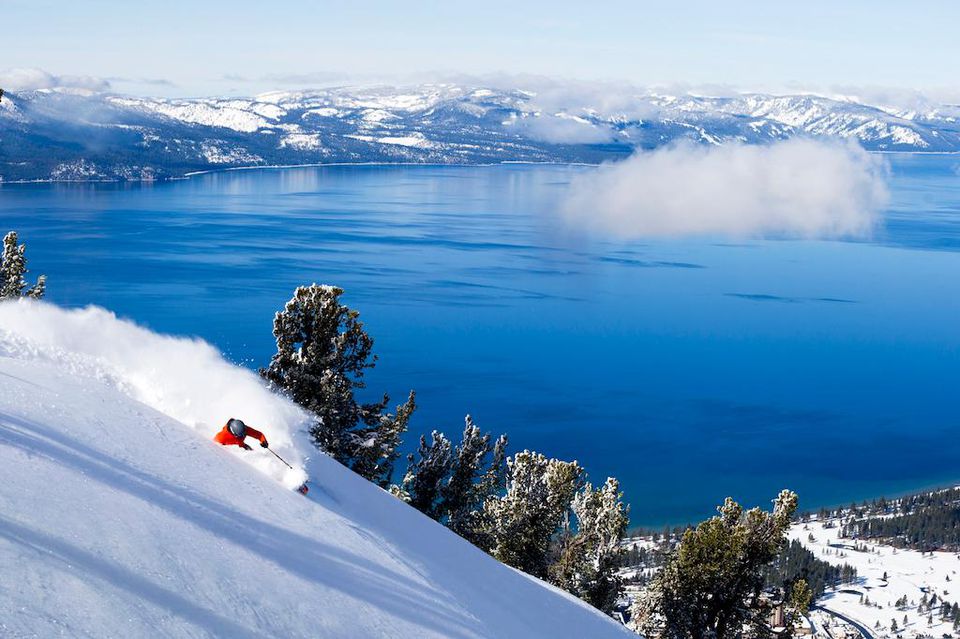
SOUTH LAKE TAHOE, Calif. – Darker than black shadows and glimmering silver capture photos that are all at once dreamlike and a crisp snapshot of reality. Alchemical symbols tell a life story in code through Ian Ruhter’s photography book capturing Lake Tahoe, the place where he both grew up and returned to.
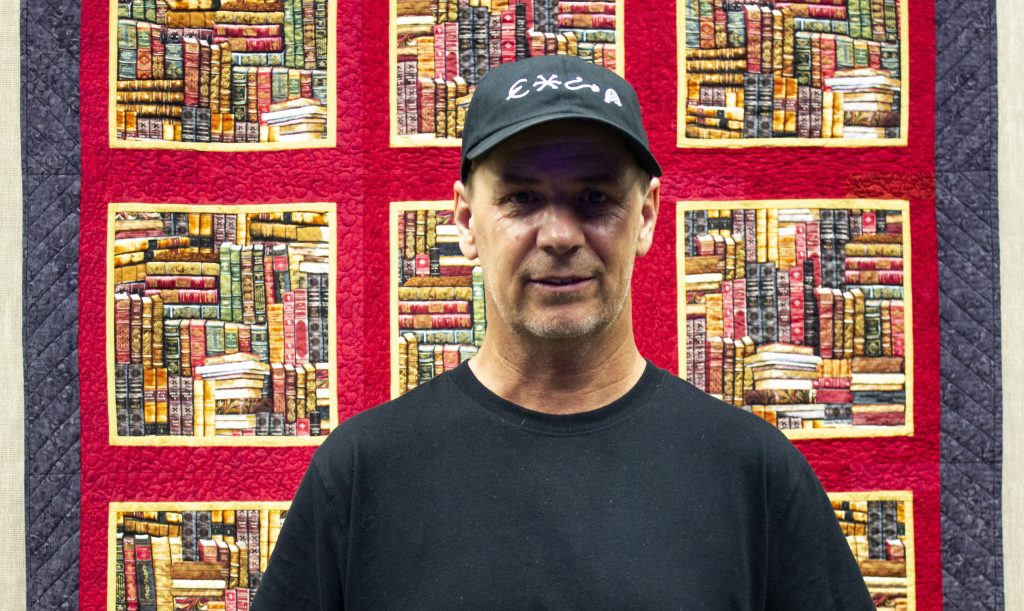
Ruhter, who uses a technique called wet plate collodion, is a world-famous photographer who pioneered a technique to capture massive photography plates through a camera he built in an old mail truck.
The photographer came to South Lake Tahoe’s library through the Friends of the Library to speak about his book, “The Lake”, the first in a series of photo collections to tell a story about his life, his memories and the powerful impact of the water at Lake Tahoe.
Ruhter grew up in Lake Tahoe and says that the natural world and his ability to explore it freely shaped how he viewed the world and inspired his creative spark. He’s been open about how he struggled in school with dyslexia. To him, it was easier to be a troublemaker and punk than to identify with his disability—and it led him to his first career in snowboarding.
But that career ended at 24, after several struggles and contending with the “party lifestyle” that many in the ski and snowboard industry face. As someone who was in the public eye, Ruhter had been photographed and it piqued his interest in exploring the art.
After taking a photography class at Lake Tahoe Community College, Ruhter said he realized, “I can communicate through photos. At the age of 25, it felt like the first time I could talk.”
Ruhter experimented with photography, with special support from his grandma, who helped him save up to get his first camera. “She was a force and such a good mentor to me.” After he practiced taking photos with film at night (a tricky process), he eventually came on a snowboarding trip to shoot photos and try to sell them.
His first day of shooting, he captured a shot that immediately sold—and launching another major shift in his career. Ruhter moved to Los Angeles and became a commercial photographer. “I had essentially made it, I’d moved out of Tahoe to the big city.”
As the age of digital photography came along though, Ruhter became disillusioned with the expectation to heavily edit photos. “That, to me, wasn’t right. My voice, which I had found through photography, was now the voice of a liar.”
To return to what he felt were his roots as a photographer, Ruhter explored old techniques and connected with wet plate collodion. By pouring chemicals over plates, he could create his own light-sensitive film, which capture silvery, grey-scale images. “The way the silver would reflect and the little imperfections were so beautiful to me,” said Ruhter.
The long processing time for the photos was also important to him. “The length of the process forces you to spend time with your subject, to appreciate the environment and who you’re working with. You get to know people.”
Ruhter was inspired to make a massive camera to capture huge wet collodion film plates. And while he was told that no one had ever managed to do what he was describing, Ruhter persisted—creating a camera out of a mail truck and specialty lens, where he was an instrumental part of the device.
Ruhter calibrates each shot from inside of the truck, preparing the film plates and loading them inside to produce the image.
“If you know anything about cameras, you know that they take the photos upside-down and backwards. And being inside of that camera, in that world where everything was upside-down and backwards, I found that I was an essential part of the camera, the machine,” said Ruhter. “It was just like my dyslexia… which I now realize, my disability is one of my greatest assets.”
Ruhter’s exploration of the chemical-heavy technique he’s now known for worldwide has led him to resonate with Paulo Coelho’s “The Alchemist” and the alchemical symbols he put in “The Lake.” In Coelho’s book, a man goes on a journey to seek treasures, and after encountering an alchemist, learns that what he sought was always right back where he started.
“The journey is important though. He needed to go on that journey to find the treasures of home,” said Ruhter, explaining how his life story connected with his return to Lake Tahoe. He told the Tribune that when he shoots photos, he’s often looking for an emotional resonance and memory—many of which he found in the place where he grew up. “I’m seeking that emotion that strikes something in me, that’s almost like déja vu.”
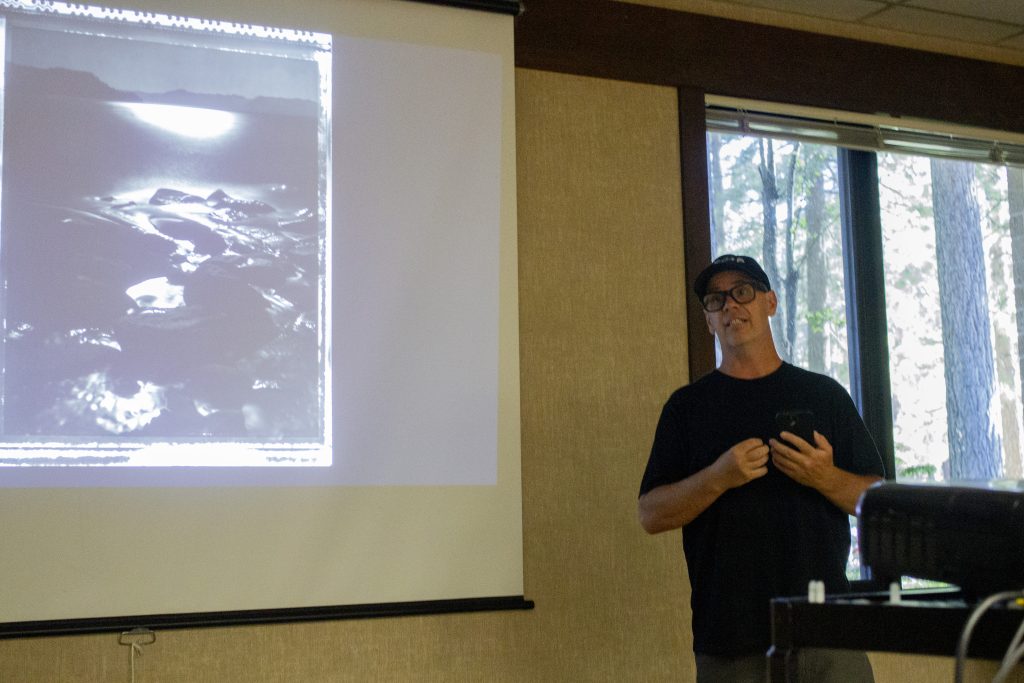
Ruhter spoke about how it was important to him to represent the Washoe people throughout the book and the next books in the series, which will follow the story of the water from Lake Tahoe, through Desolation and into Pyramid Lake. He hopes that people will resonate with the Washoe tribe and other indigenous people’s stewardship of the land and water, which he believes is a critical aspect to highlight these days.
Pre-sales for Ruhter’s next book, “Slab City” will explore the subcultures and unique society living off-the-grid near the Salton Sea. Unlike “The Lake”, which only features a single portrait of Ruhter’s daughter, Lily, among the shots of nature, “Slab City” explores human structures, relationships and “a microcosm of the United States.”
Ruhter counts himself lucky that he gets to live the life that he does, having made many decisions that led him in a completely different path. “I think it’s about following what’s inside your heart. Letting that drive you, rather than success, fame or money.”
Quoting “The Alchemist”, Ruhter said, “When you want something, all the universe conspires in helping you to achieve it. And that’s really how I feel.”
You can order the special 2nd edition of “The Lake” and pre-order “Slab City” on Ruhter’s website, ianruhter.com.