SOUTH LAKE TAHOE, Calif. — A photo circulating on social media showing a caution sign referencing glyphosate has prompted confusion among Lake Tahoe residents over whether herbicides are being applied in the basin.
The image, shared in a Facebook post on July 9, shows a yellow caution sign with the word “glyphosate” and the date “06/25/26” handwritten in black marker. The photo was allegedly taken near Tallac Point.
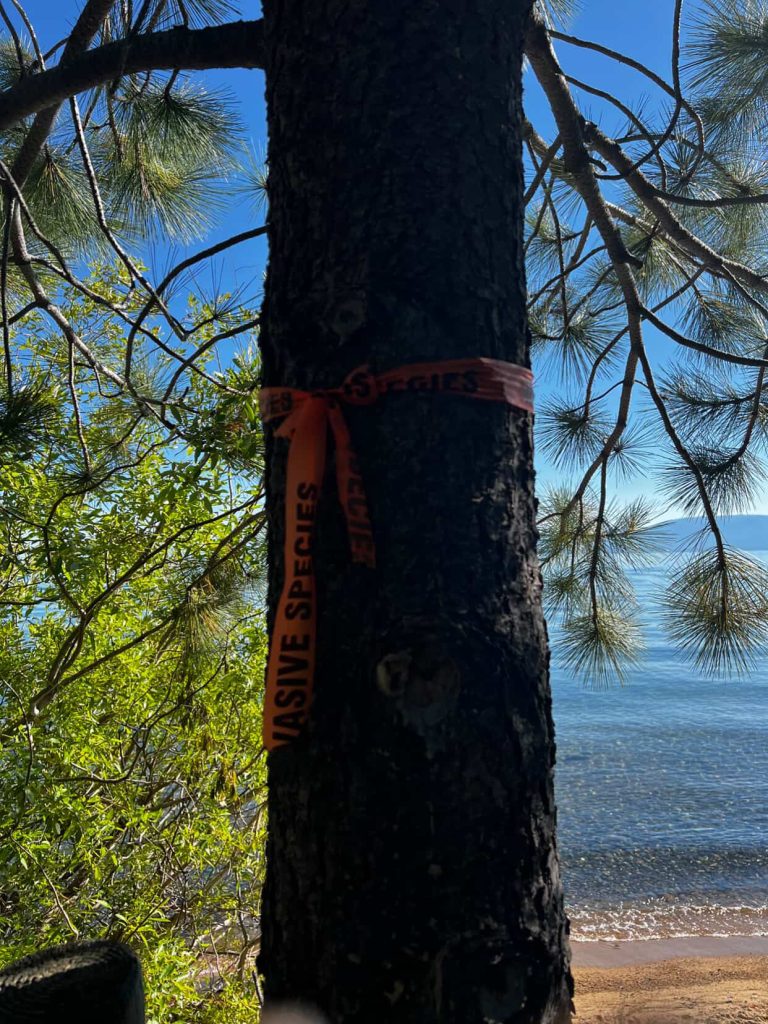
Comments on the post said the sign had been replaced with a ribbon labeled “Invasive Species.”
The controversy surrounding glyphosate has grown in recent months following a Mother Jones investigation examining the herbicide’s potential carcinogenic risks, major lawsuit settlements and ongoing debate over the extent of scientific research on its health effects.
The photo quickly drew attention online because people believed it appeared to contradict previous statements from the U.S. Forest Service regarding planned glyphosate herbicide use.
The Forest Service approved the Caldor Fire Restoration Project in March 2026, a large-scale restoration effort covering approximately 11,100 acres of National Forest System land on Lake Tahoe’s South Shore. The project includes a range of forest restoration activities, including planned herbicide treatments using glyphosate.
In an earlier statement to the Sierra Sun, the Forest Service said “No herbicide application within the [Caldor Fire Restoration] project area is expected in 2026/2027.”
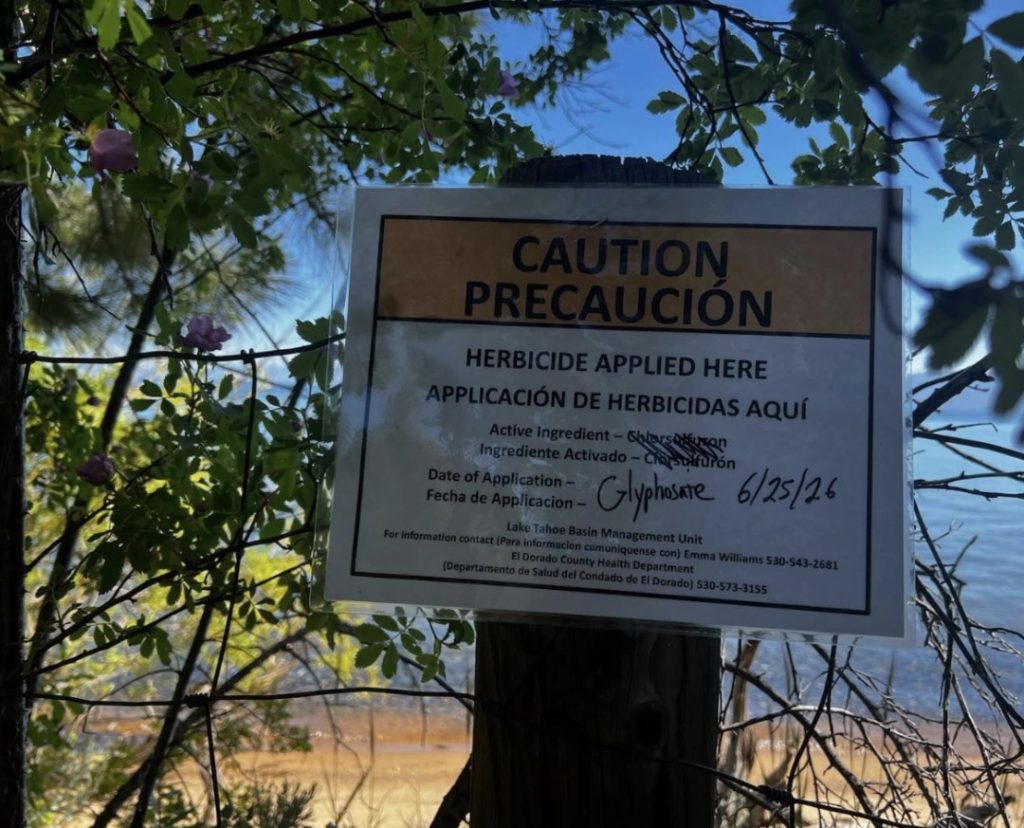
However, the U.S. Forest Service said the sign in the photo refers to a separate invasive species treatment and is not connected to the Caldor Fire Restoration Project.
In a statement to the Tahoe Daily Tribune, the agency said an aquatic formulation of glyphosate was spot-sprayed on June 25 to treat 10 yellow toadflax plants near Kiva Beach.
“This spot application is not part of the Caldor Fire Restoration Project. No herbicide applications are expected in 2026 or 2027 in the project area where tree planting is proposed,” the Forest Service said. “Herbicide use in the basin remains limited to treatments approved under the Terrestrial Invasive Plant Species Environmental Assessment.”
The Forest Service said yellow toadflax is a non-native invasive plant with an extensive root system that makes manual removal ineffective and potentially more disruptive to surrounding soils.
“The aquatic formulation was selected because it does not contain the surfactants found in other glyphosate products, which can be harmful to aquatic organisms,” the agency said. “Applications at this site were conducted with a backpack sprayer approximately 20 feet from waterways.”
According to the Forest Service, a herbicide application sign was posted on June 25 for terrestrial weed treatments in the Pope-Baldwin-Kiva area. The signs are required to remain in place for at least 48 hours to notify visitors and allow them to avoid treated areas during and after the restricted entry interval, which was four hours for the Rodeo herbicide used in the treatment. Although the minimum posting period had passed, the sign was not removed until July 7 because crews were focused on other field priorities.
The agency also addressed the ribbon visible in later photos, saying invasive species flagging was installed May 19 to mark an avoidance area for the South Tahoe Fuels Cathedral Mechanical Thinning Project. At this site, markers identify infestations of yellow toadflax and oxeye daisy so heavy equipment does not spread the invasive plants.
“These flags do not indicate herbicide application sites,” the Forest Service said.
The Tahoe Regional Planning Agency (TRPA) also said the sign circulating online is unrelated to that restoration project.
In a statement to the Tribune, TRPA said, “The Forest Service has stated no work in the project area is planned for 2026/27. Tallac Point is not connected with the Caldor Fire Restoration project.”
TRPA also noted that while herbicides are regulated in the Tahoe Basin, they are not categorically prohibited.
“Tahoe Regional Planning Agency (TRPA) regulations discourage the use of terrestrial herbicides, but do not prohibit it if the herbicide application meets requirements,” the agency said. “USDA Forest Service Lake Tahoe Basin Management Unit activities must comply with TRPA regulations that outline environmental protections for the Tahoe Basin.”