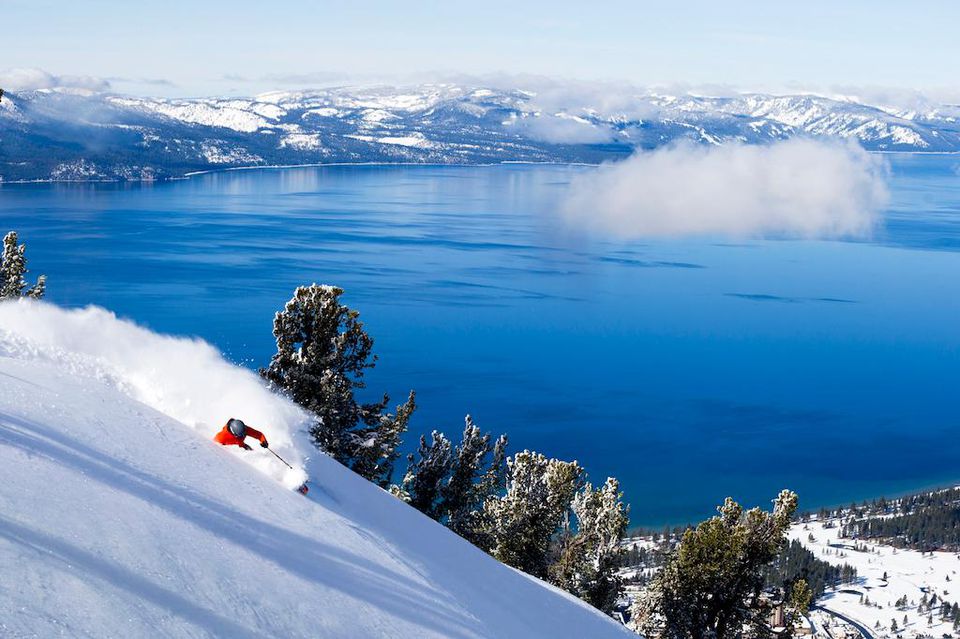
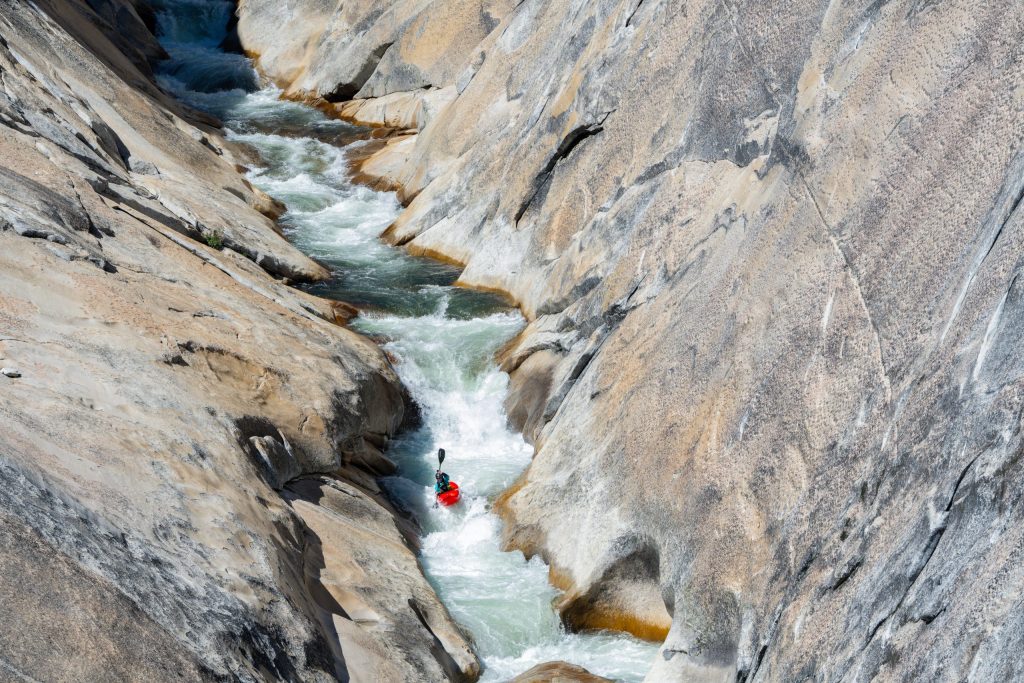
In a remote and coveted Class V section of the North Fork Mokelumne River, just outside Lake Tahoe, granite walls rise steeply above the river as whitewater crashes through a narrow Sierra canyon. The current accelerates, funneling into a sequence of powerful drops known as Fantasy Falls.
For Sage Donnelly, a Carson City competitive whitewater kayaker, running the entire stretch in a single descent — known among paddlers as the “Fantasy Flush” — had long been a major goal.
The run requires committing to one of the most demanding descents on the river and includes five notoriously technical Class V rapids. According to Donnelly, only about 20 paddlers are believed to have completed the route.
“It involved having a moment with myself,” Donnelly said. “Asking, can I do this? Do I have the ability to do this?”
For her, the answer was yes.
Before launching, her team carefully set safety along the canyon walls. At the most intimidating drop, friends positioned themselves on a ledge roughly 20 feet above the water with ropes and a spare paddle in case something went wrong. In high-risk sports, mistakes can carry serious consequences.
So when showtime came, she took a couple of breaths, splashed water on her face and launched before she could think about backing out.
When she pushed into the current and punched through the crux, the relief was immediate.
“Obviously I still had really hard stuff to do, but I knew I had it,” she said.
That day, to her knowledge, she became the first woman to complete the Fantasy Flush.
MORE THAN JUST THRILL-SEEKING
Many athletes like Donnely — are often asked the same question: Why choose to do something that appears so dangerous?
It’s common for people to question the motivation behind taking such risks, said Yani Dickens, director of counseling services at the University of Nevada, Reno and a sport psychologist.
“They think they must be thrill seekers or have extreme personalities,” he said. “But I don’t think that’s true.”
Instead, Dickens said many athletes in high-risk sports are motivated by the same psychological drivers found in other sports: mastery, competition and the pursuit of a mental state known as “flow.”
Dickens described the flow state as a “natural high.” It is a deeply focused mental condition in which a person becomes fully immersed in a challenging activity. During flow state, people become intensely aware of both their internal state and their surroundings, sometimes experiencing a distorted sense of time.
“I take a couple of breaths, turn off my brain, splash my face and then I just go before I can think about anything else,” Donnelly said. “I feel like everything slows down and I see everything, just as much as I feel like I remember nothing.”
The experience isn’t limited to sports. Research shows people can enter a flow state during many activities, from creative hobbies to professional work. Surgeons, for example, often report entering flow states during complex operations.
Dickens said the motivation behind high risk sports is often misunderstood.
“It’s not about seeking risk,” Dickkes said. “It’s about managing risk.”
THE RISK IT TAKES TO FEEL ALIVE
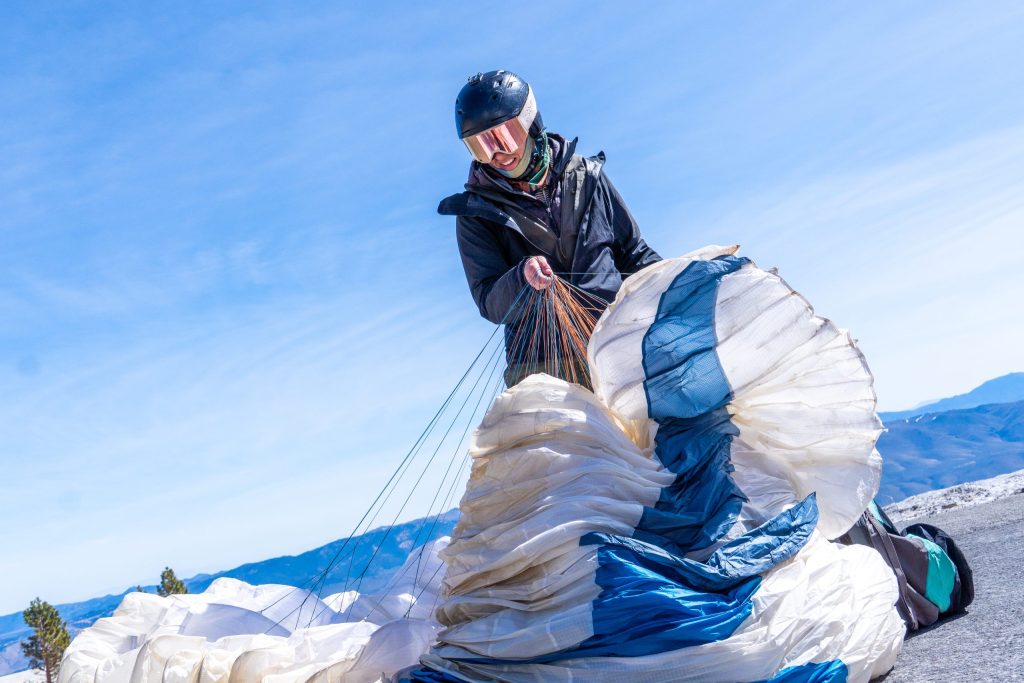
As Carrie Vockrodt climbed higher in a thermal — a rising column of warm air that allows paragliders to gain altitude — the landscape began to expand beneath her. She watched clouds build and dissipate as she timed their cycles and followed birds that led her into new thermals.
Eventually, she rose high enough to see Lake Tahoe in its full form for the first time.
“Being so high up in the air makes you feel very small, very tiny on this earth,” Vockrodt said. “When you’re up there, you’re not thinking about work tomorrow or everything you need to get done — you’re just thinking about flying.”
Vockrodt, an ICU nurse at Tahoe Forest Hospital District, has lived in the Tahoe-Reno region since 2014 and began paragliding in 2020.
“I’ve been addicted since,” she said with a laugh.
Many extreme sports share a common element: the outdoors. Uncontrollable factors such as weather, terrain and distance from medical care increase the danger. Even preventable accidents can occur when human error enters the equation.
So what makes these activities so appealing?
For many, the answer lies in the experience of being immersed in nature, said Yani Dickens. That sense of connection brings joy, but it also requires accepting a higher level of risk. For Vockrodt, that tradeoff is part of what makes the sport meaningful.
“We all live here because it’s an incredibly beautiful place,” Vockrodt said. “When you’re paragliding, you get to see the trees, the mountains, the snow and the lake from a completely different perspective.”
Risk tolerance, Dickens said, is often shaped by a mix of nature and nurture. Some people grow up in families that encourage exploration and outdoor activity, while others are raised with stronger warnings about danger. While there are exceptions, participation in high-risk sports often reflects an individual’s comfort with uncertainty.
“Life in general is just risky,” Vockrodt said. “Everything we do is risky. I think the most risky thing we do is get in a car and drive. Yet we do it every day and don’t think about the risk associated with it.”
At the same time, psychological flexibility — the ability to adapt and reassess situations — is essential in high-risk activities, Dickens said. Athletes must recognize when conditions become unsafe and be willing to turn back.
Vockrodt said that awareness is critical. Flying safely requires constant learning.
“Understanding the weather, reading books, knowing the places you don’t want to be when the wind is going in a particular direction, taking safety courses, practicing emergency maneuvers,” she said. “It’s about trying to know as much as I can.”
That knowledge helps her make better decisions in the air.
“I’m not just flying for today,” she said. “I’m flying for my 65-year-old self.”
But ultimately, Vockrodt says the reason she keeps returning to the sky is simple.
Flying, she said, “just makes me feel alive.”
Editor’s note: This article originally appeared in the Summer 2026 edition of Tahoe Magazine.