
SOUTH LAKE TAHOE, Calif. – As water temperatures begin to cool and bouts of autumn precipitation make their way across the region, Kokanee salmon spawn season has become a highly anticipated spectacle since they were first introduced to Lake Tahoe in 1944. Yet with minimal snowpack last season and early spring weather, stream flow rates are dismal, and many are wondering how the Kokanee salmon will fare this year.
Ideal water flow conditions for spawning
When water temperatures drop, it signals to Kokanee salmon that autumn has arrived. This typically occurs between late September through November. Spawning is triggered by a rush of cold water, either from tributaries or through releases from dam management seen at Fallen Leaf Lake into Taylor Creek.
In 1972, a Memorandum of Understanding (MOU) between the Fallen Leaf Lake Protection Association and the U.S. Forest Service Lake Tahoe Basin Management Unit (LTBMU) was put in place to allow LTMBU to manage the discharge of water from Fallen Leaf Lake through the Anita Baldwin Dam.
“This agreement requires us to maintain the lake elevation above a certain level on September 30 of each year,” said LTBMU Hydrologist, Robert Gibson. “After this date, the LTBMU begins discharging more water to mitigate the risk of flooding during the winter months as required by the MOU. There are no specific thresholds for the discharge schedule, and we strive to balance a variety of resource needs with the existing water conditions.”
In ideal Kokanee spawning conditions, sandbars caused by dry periods are washed away from the mouths of creeks through both snowmelt and precipitation, creating an influx of stream flow. Because Kokanee salmon are landlocked, they rely on this stream flow.
We saw these perfect spawning conditions in 2021 when a historic, late October atmospheric river storm brought downpours that flooded Taylor Creek, allowing the Kokanee to swim upstream to spawn.
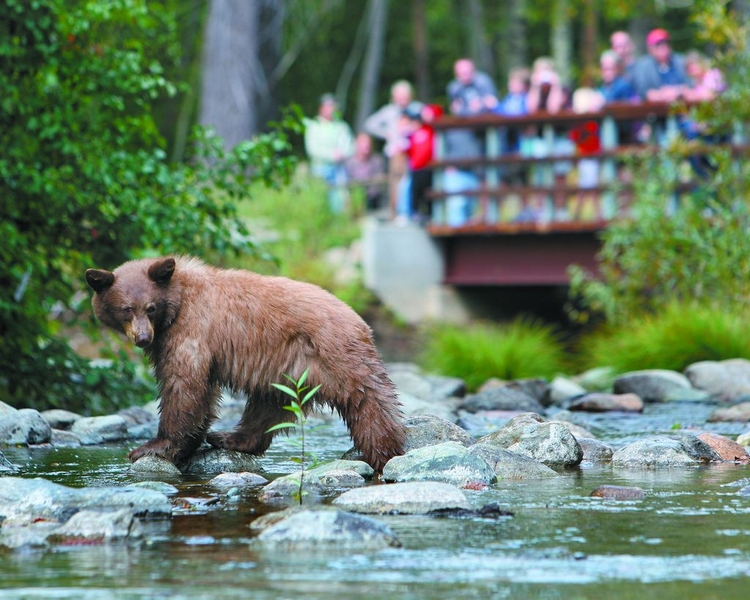
When successful Kokanee salmon spawning takes place, it fuels the ecosystem. Because the salmon die shortly after spawning, it creates a high-calorie feast for wildlife before winter sets in. Bears, bald eagles, ospreys, river otters, minks, coyotes and raccoons, along with scavengers like the Steller’s Jays and crows, all reap the benefits of a thriving spawn season.
Current conditions causing delays
According to LTBMU Aquatic Biologist, Sarah Muskopf, stream flows and water availability in the majority of streams entering Lake Tahoe are at their lowest conditions in the fall because they are snowpack driven. Although some streams have groundwater influences and can provide more consistent flows, this is not the case for Taylor Creek.
Due to the lack of the snowpack from the previous winter season, mixed with little precipitation throughout the months of September and October, current conditions for Kokanee to spawn are not very optimal because of a lack of water storage.
“This means we release flows when natural precipitation is in the forecast so when fall spawners are triggered by environmental cues (in this case increased flows) and move upstream, the flows can be maintained to ensure the entire reproductive cycle can be successful,” said Muskopf. “Redds (eggs) deposited by Kokanee need sustained flows that provide cold and well oxygenated water. After the eggs are laid, they incubate in the gravel for a few months and need sustained flows for survival.”
Muskopf notes that the highly anticipated annual salmon run relies on the entire reproductive cycle to be successful.
“We not only need to use the available flow to trigger upstream movement of adult kokanee (typically 2-4 years old) but also the flows to support egg and fry development,” explained Muskopf.
Unless there’s enough water to provide sustained flows from the initial release in the fall through the following April, weather and forecast depending, the run will happen later in the fall, possibly in the months of November into December.