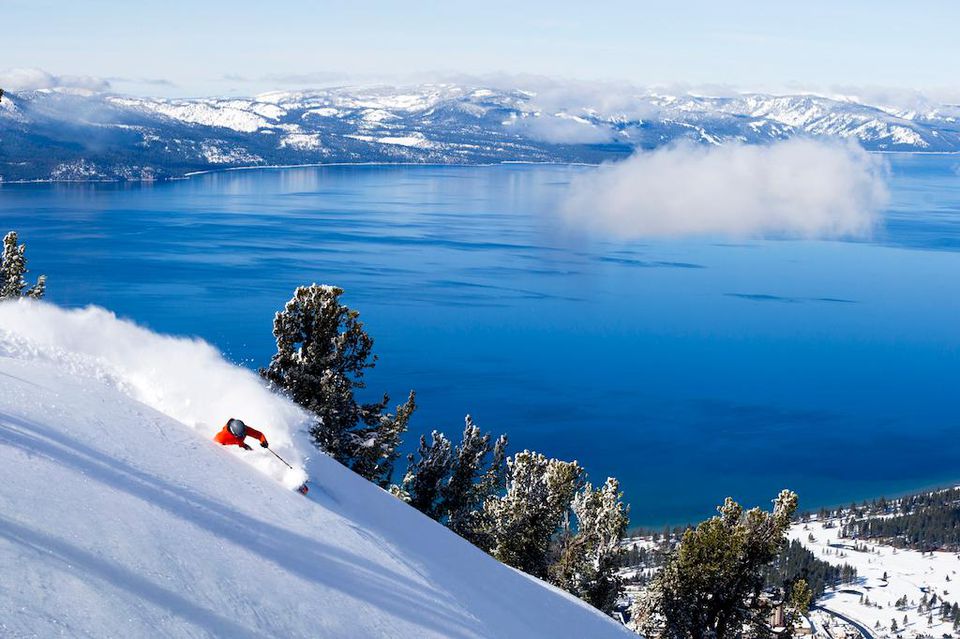
Spanning 2,000 acres, 50 trails, and 2,212 vertical feet of fun, Sierra-at-Tahoe is celebrating its 80th anniversary this 2026/27 winter season.
It all started back in the 1940s at the end of World War II when Ray Barrett drove out from the East Coast to attend school at Sacramento City College. He was in the ski club when he saw a hill on the side of the road on the way to Lake Tahoe that he thought would be skiable and had a meeting with the US Forest Service to discuss the feasibility of building a ski resort there. That same year, his brother Floyd got discharged from the Navy and was unemployed, so Floyd and his wife drove out towing their 1915 Model T Ford cross-country to help Ray open Sierra Ski Ranch.
Sierra Ski Ranch opened on December 21, 1946, with a rope tow and a Poma lift. In 1953, the Barretts sold Sierra to longtime locals Vern and Bobbie Sprock who ran it for the next 40 years.
During that time, Caltrans decided to redirect Highway 50 to the northern side of the American River, which pushed the ski resort to a different location. After the approximately $1 million roadway project, Sierra Ski Ranch reopened on December 21, 1968. It had a base lodge and Nob Hill chairlift, which still runs to this day.
“I take runs on it pretty much every day,” says Sierra-at-Tahoe Communications and Content Manager Jake Stern. “It takes you to Avalanche Bowl and the upper main terrain park. It’s a nice slow chair that takes you to the top park and you can escape to West Bowl.”
The Sprocks also brought over their rope tow and Poma lift.
Sierra Ski Ranch slowly added more chairlifts and opened up more terrain after that, with notable lifts such as the Tahoe Queen (a fixed grip double chair installed in 1972) taking skiers up to Huckleberry Canyon for the first time and then replacing it with the Sensation, a high speed detachable quad built in 1989.
In 1993, the Sprocks sold Sierra Ski Ranch to Fibreboard Corporation. Fibreboard changed the resort’s name to Sierra-at-Tahoe and hired John Rice as its new general manager.
John Rice Reinvents the Culture at Sierra-at-Tahoe
Rice originally started his ski industry career at Palisades Tahoe (then called Squaw Valley) as its first college intern, later becoming its director of mountain operations. He worked there until 1982 before taking a job at Snow Summit and moved over to Bear Mountain Ski Resort in fall of 1988. It was while Rice was at Snow Summit when snowboards were invented; and he risked his career to help the sport progress.
“I was approached by Tom Sims (early snowboarding pioneer) asking if I was interested in letting people ride these new kinds of boards at the resort and building some features. The resort didn’t allow snowboarding, but I was kind of bored and interested in this.
“They were lead sleds at the time and that crew wanted to form a feature that was like a frozen wave,” Rice recalls, explaining a shape that would be later known as a snow-sculpted halfpipe.
Rice really wanted to do this, so at the risk of not losing his job he held night skiing and let snowboarders come in and build little jumps, tearing them down by the morning.
But he still got called into the president’s office.
“My boss asked if we were joyriding at night. He said snowcats were coming in with bent frames and extra hours on them. I admitted we’d been building new terrain,” Rice says.
He still got fired, but it became the genesis of snowboarding. He went next door to Bear Mountain and built the first-ever terrain park in the world, then brought that to Sierra-at-Tahoe.
With it having South Lake Tahoe’s only terrain park at the time, snowboarders began claiming Sierra-at-Tahoe as their home mountain.
“Shaun Palmer was the pied piper of them,” Rice recalls. “We built amazing playgrounds and word got out real fast. The park was fun…it was a lot of trial and error but truly embraced by that culture,” he adds.
Sunshine Alley was especially popular with the snowboarding crowd. “It was a beginner trail on the backside that was seldom used and perfect for building jumps, tabletops, and boxes. It was in that latter half of the nineties and early 2000s when snowboarding really began to take root at Sierra-at-Tahoe.
“Sierra-at-Tahoe offered a cool sense of place; it was the first playground that bred these families learning tricks and going on to win contests. Jamie Anderson and her family cut their teeth there,” Rice recalls, talking about the Sierra Elite Team member who became the youngest competitor (and gold medalist) at the Winter X Games. Sierra’s Elite Team went on to clinch titles in big competitions, such as Travis Cabral winning the U.S. World Cup Moguls Championship and Hannah Teter later winning the Olympic Gold in Women’s Halfpipe.
“I remember when Hannah Teter came over one day with her brother; she primarily rode Kirkwood but asked if they could ride here because we had a halfpipe. They were very invested in our type of terrain because Hannah wanted to win a gold—and she did. We offered her two passes the following year,” Rice says.
“Jamie always says Sierra-at-Tahoe was her daycare. We built the stuff they needed to learn the tricks they wanted to do and compete.” Sierra-at-Tahoe continued churning out professional snowboarders as well as freestyle skiers like Maddie Bowman. About 10 years ago Sierra-at-Tahoe created the Dynamite run, which was nice and flowy for skiers.
People always ask Rice how Sierra-at-Tahoe has been able to churn out so many athletes, to which he says the resort has always committed to giving these local kids what they need to excel in these big competitions.
“It was about removing the drama and getting the rocks out of their path, giving them a place to play. We’re at 2,000 acres and that’s a lot of terrain to play on that’s comparable to the other resorts. People ask, ‘What’s in the water over there?’ We have good coaches committed to supporting the kids and great terrain; this is where the energy is,” Rice says.
“If they got on the podium then we’d reimburse their travel, all their contest fees. You just had to be a good person, be respectful towards others; if you follow the Golden Rule then Sierra is your home. Everyone is welcome here; it doesn’t matter if you wear tight jeans or what you look like; we have the highest diversity rate of skiers and snowboarders in Tahoe.
“We’re focused on making the guest experience the best it could be and making guests feel like they’re not just a number. When we opened the sun deck, we noticed something really cool— groups of parents were going skiing and taking turns watching each other’s kids. We gave them a place to come and hang out. We tried to put out the message that you’re appreciated here…this is a place to get fresh air and see some friends. Around us as things became corporatized and the [Tahoe ski] culture was changing, Sierra kept that welcoming, fun, light spirit. We were playful but serious about safety,” he adds.
The 2000s and 2010s were years of Sierra-at-Tahoe athletes winning gold medals and claiming podiums, but then the 2021 Caldor Fire came.
Preserving Through The Flames
When asking what Sierra-at-Tahoe’s most challenging years/seasons/events were in its 80-year history, Rice believes that the 2021 Caldor Fire was the ultimate test of the resort’s mettle. “No question. It just wiped out 80 percent of the terrain,” he says.
However, in its 80 years of operation, Sierra-at-Tahoe had always tried to be there for the community and the Caldor Fire showed that the community returned the favor in the resort’s own time of need.
“John Rice had a very clear vision of how we were going to reopen Sierra [after the Caldor Fire] and reforest it,” Stern affirms. “And I think there was also a big rallying cry from the ski community to rebuild,” he adds. Sierra-at-Tahoe completed its reforestation project in 2026, planting over 60,000 saplings in conjunction with the US Forest Service and El Dorado Resource Conservation District.
Rice agrees that Sierra-at-Tahoe’s years of paying it forward with the community made a big difference.
“We were the largest employer in the region, so we had to set an example. We did a straight A program with the schools (where students could earn a season pass) and gave teachers a discount on season passes. We gave a lot of people their first jobs and tried to show that we really did care. A lot of people came to work for us because we had good corporate souls,” Rice says.
“There’s a real DIY ethos here, an attitude of ‘we’re going to rally the troops and do what it takes to keep Sierra-at-Tahoe going.’ We have such a good relationship with the community where we’re willing to step up to help, and the community does the same in return. We’re lucky to have a really caring community in South Lake Tahoe,” Stern adds.
What’s In Store For the Future of Sierra-at-Tahoe
About what’s in store for Sierra-at-Tahoe’s future, current General Manager Dan Healy offered this statement:
“We are focused on creating exceptional guest experiences while preserving the mountain environment that makes Sierra so special. That includes continued investment in infrastructure, forest health, wildfire resilience, technology, and services that improve the guest journey from planning a visit to making turns on the mountain.
“We’re also committed to growing participation in skiing and snowboarding by reducing barriers to entry and creating more opportunities for young people, families, schools, and community organizations to experience the sport. We’re proud to be one of the most affordable resorts in Tahoe. The long-term health of our industry depends on welcoming the next generation of outdoor enthusiasts.
“Most importantly, Sierra’s future is built around our community. After 80 years, we’ve learned that the strength of Sierra isn’t just our mountain, it’s the employees, guests, partners, and locals who care deeply about this place. That community will continue to guide our next chapter.
“Throughout Sierra’s 80 years, our community has remained the backbone of what makes this mountain special and successful. From their overwhelming outpouring of support during the Caldor Fire to the generations of families who call this mountain home, we wouldn’t be who we are without our guests and our employees who bring Sierra’s special spirit to life.”
Editor’s note: This article originally appeared in the Winter 2026/27 edition of Tahoe Magazine.