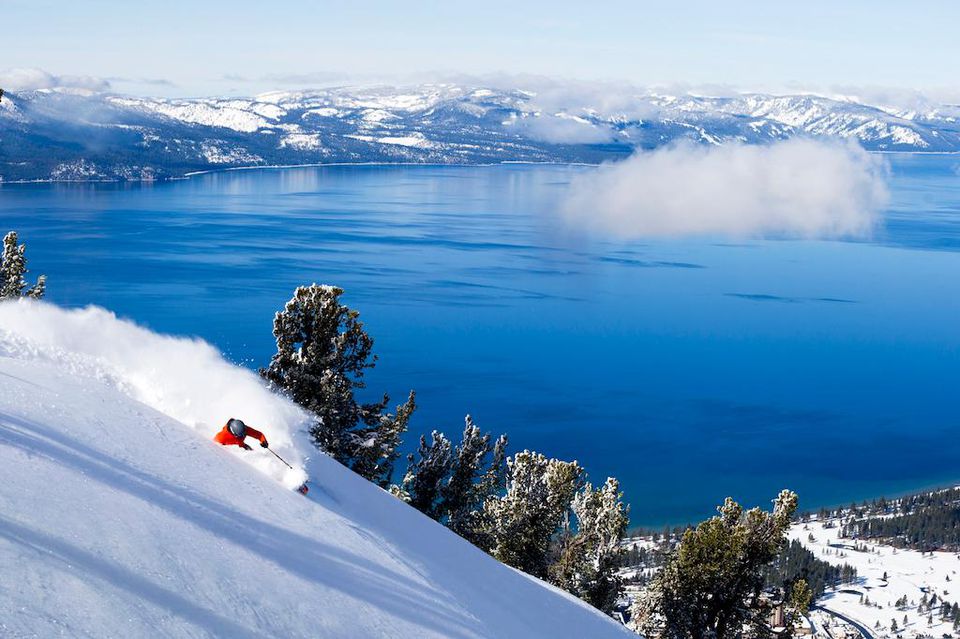
When Worlds Collide: Skiing and Writing on a Warming Planet
This winter was a wake-up call for me. The unseasonably warm temperatures that became ubiquitous with every weather report, the fall weather that dragged into the end of December, and rain instead of snow all led me to an uncomfortable realization — climate change is here. Now I find myself grappling with the reality of our changing climate as both a ski industry professional and an environmental journalist. I am beginning to find these markedly separate careers colliding in ways I hoped they never would.
In 2023, when I first began my foray into journalism and transitioned from full-time ski patroller to full-time student and part-time patroller, I wrote an article for a science reporting class at UNR on a study published in the scientific journal Climate Dynamics. My article was titled Must Go Higher: New Study Predicts Warmer Winters and Higher Snowlines for the Tahoe Basin. I thought the portrait of a Tahoe that was impacted by climate change was still in a very far-off future. I was wrong.
When I found more dirt than snow this past December and opted for hiking and biking in place of skiing, I couldn’t help but think back to the lines I wrote just a few seasons ago:
“A study tracked the snowpack in the Sierra over the past 70 years and found a stark rise in snowlines … Under unabated climate change conditions, the Sierra will lose approximately 57 percent of their snowpack in the second half of the 21st century.
“Most of this snow loss is predicted to happen during the shoulder seasons of fall and spring, and at mid-elevations. Not only would the ski season window shrink, but so will the area of skiable terrain as snow becomes relegated to the highest and coldest of elevations and the chilliest of months.”
This fall, I kept waiting for that feeling of a cold breeze on my face or a frosty morning with the delicious crunch of frozen earth underfoot to tell me winter was on the horizon. When halfway through December the mountains were still mostly bare and instead of snow I had fresh strawberries in my garden in Carson City and confused irises sprouting out of the earth, I began to officially freak out.
A small bit of solace came from scientist Benjamin Hatchett of Colorado State University. He reminded me that recency and confirmation biases can play a large part in our perception and that unless I had specific long-term data surrounding said strawberry harvest, it could have some aspects of natural variability entwined in it, alongside climate change.
One piece of relief came when I asked him about the long dry spells we had earlier this season. He had run the numbers.
“So, I just took the longest dry spell period of each winter and then you see if there’s a long-term trend there. And, so, we don’t see a signal for the dry spells getting longer with time, which is good. There is a lot of variability, which is not surprising,” Hatchett said.

Although that high pressure system may have turned out to just be a dry spell, it did also serve as a potential dry run for what we may see under a warmer, less snowy future.
“We should learn from what happened in these low snow years because that’s what we expect to see more of,” said Hatchett. “So, how do we manage that in different ways? How do we try to ski what you can? And use the water more wisely?”
Whether a dry spell is a dry run for the future or not, this winter’s warm start gave many of us a run for our money, literally. Seasonal workers can relate to the anxiety of a shoulder season that drags on. As a seasonal employee, you rely on stacking cash in the peak summer months to squeak through the lean season into winter where the promise of work awaits come November.
But halfway through December this year, most mountains were only operating at a fraction of their footprint, if at all. The high season was around the corner, but we were missing a very important element — snow. For many, it was either get another job, dig into savings — if there are any — or fill out unemployment paperwork.
This loss of revenue is costing the economy millions: around $252 million annually to be exact, according to the 2024 article How Climate Change Is Damaging the US Ski Industry. The piece, published in the peer-reviewed journal Current Issues in Tourism, found that by the 2050s, ski seasons are projected to shorten between 27 to 62 days under unabated climate change, resulting in a loss of over a billion dollars annually. This is for the industry as a whole, but I fear what the local implications will be.

I return to my words from seasons ago:
“Much of the Tahoe Basin’s skiable terrain is at mid elevations, but it is these precise elevations that are now hanging in a delicate balance, dancing a fine line between above and below freezing temperatures.
“The Central Sierra snow line currently sits at an average between 7,380 – 8,200 feet above sea level during the peak snow season. In the second half of the century, that number is projected to rise to between 8,690 and 9,020 feet.
“This spells trouble for the Basin, as the majority of Lake Tahoe’s skiable terrain is between lake level at 6,225 feet and around 9,000 feet.”
Put simply, we are going to run out of mountain.
Andrew Schwartz, director of the UC Berkeley Central Sierra Snow Laboratory and Protect Our Winters science alliance member, already sees the writing in the snowpack.
“We are starting to see our winter precipitation switch to more rain than snow,” Schwartz said. “We see the shoulder season — months like October, November, May, April — those are transitioning really quickly. Even December is moving very quickly towards a rain-dominated month. And those signals are from the 1970s forward. They’re also accelerating.”
It’s not just scientists who are witnessing this but many other ski and snow professionals. Brennan Lagasse, a professional ski guide with decades of experience in the Sierra and a sustainability professor at the University of Nevada, Reno at Lake Tahoe, said: “You’re losing quite a bit of skiing from lake-level up right now. In Lake Tahoe, a great but sad example is Homewood … Homewood skis right down to lake level. Over the past few years… we’re getting much more rain on snow events than we have in the past.”
The probable future of snow in the region is laid out in stark detail in the 2021 scientific paper A Low-To-No Snow Future and Its Impacts on Water Resources in the Western United States, published in Nature. And for someone who loves and relies on snow for enjoyment and employment, the future is pretty damn bleak.
The paper stated that the onset of low-to-no-snow seasons will occur in the 2060s for most basins in the American West, but in California this will appear in the late 2040s. And under unabated climate change, or business as usual conditions, we have between 35 and 60 years before low-to-no snow becomes persistent across the West. In addition, the article found that in the Cascades and the Sierra Nevada, around 45% of losses are expected by 2050.
In other words, unless drastic reduction in emissions happens, and fast, our snowpack is f*cked.
The authors did caution that the exact time frame of the emergence of these low-to-no-snow conditions is highly variable based on the models used. Regardless, the question is no longer if but when.
“Realistically speaking in the West, we’re kind of at a tipping point. We’ve seen climate change impact our winters. We’ve seen that start to accelerate,” Schwartz said. “Around 2025 to 2035 is when this is going to really shift how our winters look in California and the Western U.S.”
He added that although there is not necessarily an average year, especially with the boom-and-bust nature of the Sierra Nevada snow patterns, that as climate change progresses there will be even larger variability.
“It’s not to say that we won’t get snow, but it’s going to be kind of punctuated by bigger periods of rain and warmer temperatures,” Schwartz explained. “I think this year’s a really good analog for what we’re going to see more of in the future before we transition to being rain-dominated towards the end of the century.”
Having the understanding I do of snow and how resorts function through my experience as a patroller both within the Tahoe Basin and internationally, to say I am concerned is an understatement. I don’t think people realize how quickly this is barreling toward us. I know I didn’t.
“I always tell people, if you want to know what is to be expected for the future of winter, look at what all the ski resorts are doing, and they’re all installing mountain bike trails,” Schwartz said.
The Tahoe Basin is changing. Our snowpack is changing.

Perhaps it is apropos that when I wrote that initial article, it too marked a transition in my career from the ski world to journalism. Just a couple of seasons ago, the impacts of climate change seemed far away. Somehow it feels closer now. I knew I would always worry for the next generation’s future, but it’s happening before our eyes. And this season it hit me, and now I worry about not only my future, but that of my friends and my colleagues, and for our careers.
Now as I revisit this original article again, likely with many more climactic and personal transformations looming on the horizon, I am discovering yet another newfound perspective. Among all this worry and fear, there also lives an inextinguishable spark of hope, of joy for the sport in whatever form it takes. And even as the future warms, this spark is stoking a fire in me to get after it, and to ski ’em while I got ’em.