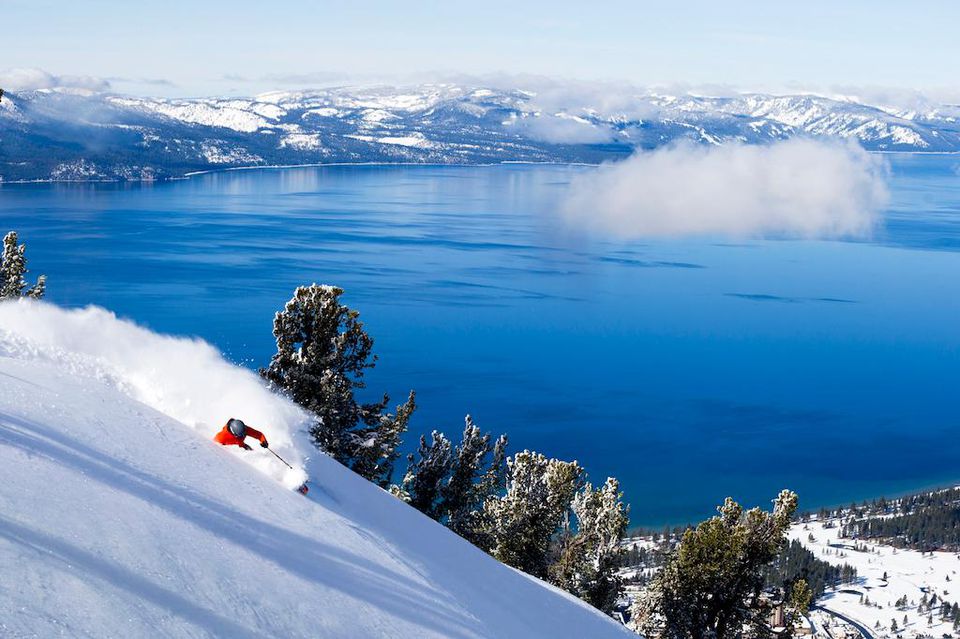
LAKE TAHOE, Calif./Nev. — Collaboration across state lines, restoration of wetlands and meadows, and partnerships with the Washoe Tribe are among the most important strategies for protecting Lake Tahoe as it faces growing pressures from climate change, invasive species and increasing visitation, conservation leaders said Wednesday during a California Natural Resources Agency panel.
The discussion, titled “Conserving California’s Iconic Waters: The Future of Lake Tahoe, the Salton Sea, and Clear Lake,” featured leaders from organizations working to restore and protect the state’s largest lakes. During the Lake Tahoe portion of the panel, representatives from the California Tahoe Conservancy and the League to Save Lake Tahoe discussed how decades of regional cooperation have shaped restoration efforts and what challenges lie ahead.
Jason Vasques, executive director of the California Tahoe Conservancy, said Lake Tahoe’s geography makes protecting the basin uniquely complex.
“Lake Tahoe sits on the California-Nevada border, spans four counties and is the homeland of the Washoe Tribe,” Vasques said. “We have to manage it collaboratively.”
That collaboration is especially important given Tahoe’s popularity. Vasques said the basin receives more visitor days than any national park in the United States, driven by its reputation as a world-class ski destination and outdoor recreation hub that supports a multi-billion-dollar tourism economy.
For more than three decades, approximately 80 agencies and organizations have worked together through the Environmental Improvement Program, a bi-state partnership created to restore Lake Tahoe after decades of environmental degradation.
“The Environmental Improvement Program was initially established to help address some of those historical impacts that we’ve seen in Lake Tahoe, like logging and grazing from the 1800s and the major development boom in the late 20th century, which resulted in the loss of meadows and wetlands,” Vasques said.
Today, those historical impacts are compounded by climate change, including increasingly severe wildfires, declining snowpack, warming lake temperatures and the spread of aquatic invasive species.
“When you couple those with visitation and the many different uses of the environment, our challenge is how do we protect this unique environment and manage it in such a dynamic setting?” Vasques said. “The good news is there is so much opportunity right now.”
He said statewide initiatives such as California’s 30×30 conservation goal and Outdoors for All are helping guide restoration priorities, while partnerships throughout the basin continue to expand.
“We’re working with the Washoe Tribe to learn how we can steward these lands; lands that have been stewarded for eons before us,” he said. “We’re working across the board with our tourism sector, nonprofit sector, business sector and all of our agencies to figure out how we manage recreation and the environment together.”
Among the largest restoration efforts underway is the Upper Truckee River Marsh restoration, which aims to restore roughly 1,000 acres of mountain meadows and wetlands.
He also highlighted the Washoe Tribe-led restoration at Meeks Meadow, a 213-acre restoration project on the lake’s West Shore being completed in partnership with the U.S. Forest Service, the California Tahoe Conservancy and nonprofit organizations.
“The partnerships and collaboration are just part of Tahoe’s DNA,” Vasques said.
Darcie Goodman Collins, chief executive officer of the League to Save Lake Tahoe, said the basin’s collaborative approach has been built over decades of environmental advocacy.
“Tahoe isn’t just unique from an ecological and awe-inspiring perspective,” she said. “It also has this really complex political system, sitting between two states and multiple jurisdictions.”
She noted that concerns over declining lake clarity first emerged in the 1950s, while record-low clarity measurements in the late 1990s brought national attention to Lake Tahoe and helped launch the public-private partnerships that continue today.
“The League to Save Lake Tahoe has been working to protect Tahoe since the 1950s,” Goodman Collins said. “We use advocacy, science and community engagement, a very well-rounded, holistic approach.”
One advantage of nonprofit organizations, she said, is their ability to respond quickly to emerging threats.
Following the 2021 Caldor Fire, the League mobilized volunteers to collect water samples and monitor sediment entering the lake, helping scientists better understand wildfire impacts.
More recently, volunteers have been educating boaters and paddlers about preventing the spread of golden mussels, an invasive species that has rapidly expanded throughout California but has not been detected in Lake Tahoe.
The League has also helped secure private funding for major restoration projects, including the acquisition of land for the Upper Truckee Marsh restoration, and successfully advocated for the removal of a lead telecommunications cable from Lake Tahoe.
Goodman Collins also highlighted new technologies, including a beach-cleaning robot and Clean, Drain, Dry stations that help recreationists clean paddleboards and other watercraft before entering or leaving the lake to reduce the spread of invasive species.
Community volunteers also continue to play a significant role in Tahoe conservation efforts.
In 2025, approximately 1,500 volunteers donated more than 7,500 hours to citizen science and environmental stewardship projects, Goodman Collins said. The data collected through those volunteer programs has supported advocacy efforts that led to bans on single-use plastic water bottles, plastic bags and polystyrene products in South Lake Tahoe.
Panelists also noted that wetland restoration has become a common strategy across California’s major lakes because healthy marshes naturally filter sediment and pollutants before they enter the water.
Vasques concluded by pointing to Lake Tahoe as an example of bipartisan environmental cooperation.
“It’s a remarkable team,” he said. “Environmental protection at Tahoe is truly a collaborative effort.”
He praised Nevada agencies for their continued partnership with California despite political differences between the two states.
“While our leaders might have political differences in other areas, the State of Nevada and its agencies have been incredible partners.”