
SOUTH LAKE TAHOE, Calif. – City council crafted a resolution targeting glyphosate and other herbicide use in the region and vastly expanded upon the original scope of action city staff had prepared at its special meeting on Tuesday morning.
The intention, as made clear by city council, is to take every action the city legally can to prevent the use of pesticides in the city and Tahoe basin. Those possible actions, as made clear by the city attorney, are quite limited.
Glyphosate’s use has become a hot button issue in Tahoe ever since the Lake Tahoe Basin Management Unit got authorization to potentially spray it on up to 3,600 acres of the Caldor Fire burn area to help vulnerable sections reforest. Glyphosate is a widely-used herbicide that was the original active ingredient in the weed-killer Roundup (now it’s only in professional-use Roundup).
On a high level, the resolution will ban the use of pesticides on city property (the city doesn’t currently use any) and directs staff to send several letters advocating against herbicide use in the Tahoe Basin, publish safe herbicide disposal practices to discourage residential use, ask the local water board to increase water quality testing after any herbicides are applied and explore legal options for a future citywide ban and means to force the Tahoe Regional Planning Agency into taking action.
Frustration with TRPA’s inaction
Councilmembers’ main concern was the fact that no agency, particularly the Tahoe Regional Planning Agency, has taken action to prevent glyphosate’s use in the Tahoe Basin. Mayor Cody Bass said preventing herbicides from being sprayed in Tahoe is one of the rare issues that almost everyone agrees on.
Glyphosate was classified as “probably carcinogenic to humans” by the World Health Organization in 2015. But the U.S. Environmental Protection Agency found no risks of concern in its 2017 human health assessment of glyphosate, and it continues to consider the herbicide safe when used as directed on the label. The EPA is conducting an updated human health assessment based on more recent science, expected in late 2026.
Council talked about how herbicides are linked to environmental destruction and cancer, the risks of exposure for those who use the affected areas for recreation, the potential for herbicides to contaminate the city’s water supply and general objections to herbicide use in Tahoe’s fragile environment.
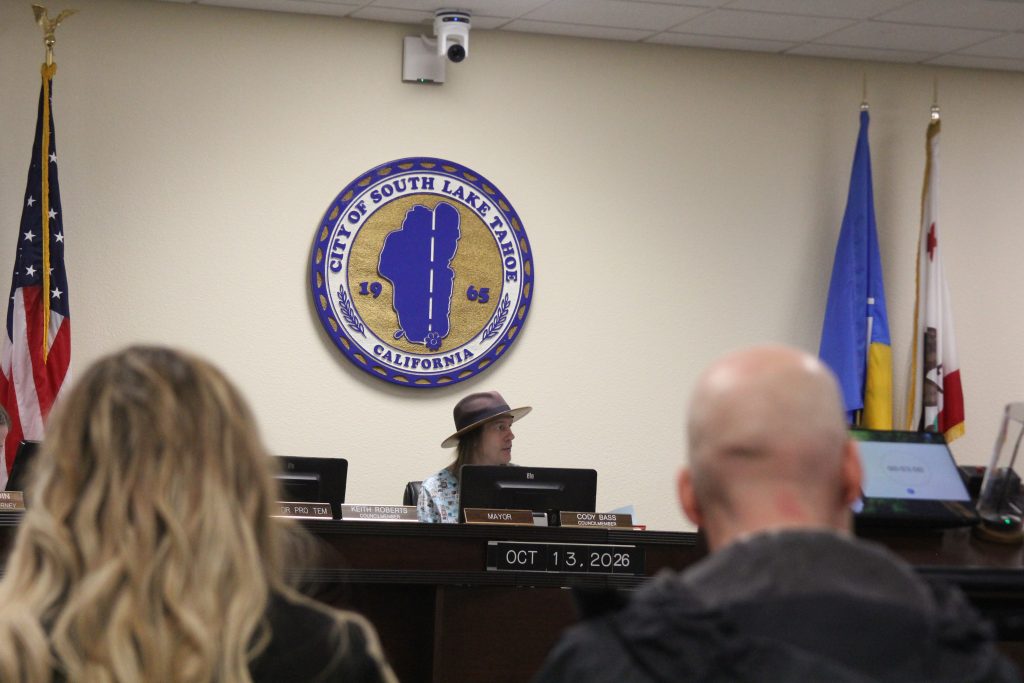
Councilmember Heather Horgan said the Tahoe Basin shouldn’t be a “test case” for using herbicides to reforest.
Federal and state laws prevent cities from passing local laws limiting pesticide use, and all of the area of the Caldor Fire Restoration Project is outside of city limits.
Multiple members expressed their frustration that the TRPA, took no action despite hundreds speaking in opposition to its use over four hours of public comment to oppose glyphosate spraying at its meeting.
“We live under so many inane environmental rules that [TRPA] put down on us as to how big our decks can be and to whether or not we can have a gravel or a paved driveway,” Councilmember Scott Robbins said. “But somehow they’re going to ignore putting poisons in the forest. It’s an absurdity, if not an obscenity.”
Some 18 people spoke during public comment at the city’s meeting, almost all in strong opposition, and city council incorporated some of the public’s suggestions into its modified resolution.
City council is pursuing aggressive action against herbicides, within its authority
City council expanded the resolution from only mentioning glyphosate to covering all “conventional herbicides” in terms of its city property ban and advocacy.
One of the most notable changes to the resolution at Tuesday’s meeting included adding that city council “demands” TRPA meet its obligations under the Bi-State Compact to protect water and soil quality by banning the use of pesticides in the Lake Tahoe Basin.
Council added a clause that says if TRPA fails to do so, it will explore all legal remedies. While they made it clear that the city council is not currently threatening legal action against TRPA, they said the council will not rule out the possibility if TRPA fails to comply.
“We should be putting a warning shot to the TRPA that if they don’t properly exercise their authority that they are required to, that there might be litigation at the end of that tunnel,” Councilmember Robbins said, as he advocated to include a specific legal threat.
City council also directed staff to explore some legal “gray areas” where there is little precedent to ban pesticide use within the city limits. State law prohibits cities from outright banning pesticides, but California’s attorney general has indicated that cities could do so for specific land uses.
By banning pesticide use under the city’s area plans, which dictate land use, and gaining approval from the TRPA, which is mandated to review area plan amendments, city council hopes it could use the TRPA’s authority to supersede state law. City council will also send a letter imploring state officials to change that law and allow localities to regulate pesticide use.
Commenters encouraged the city council to explore circumventing state law to ban pesticides and exploring legal action against the TRPA.
“Let’s test the legal waters before we test positive for glyphosate on our waters,” one commenter said.
In terms of advocacy, the council will send letters to the U.S. president, the U.S. Forest Service, federal and state lawmakers, TRPA board members and virtually anyone else with authority over pesticide use.
As Councilmember Scott Robbins put it: “We have indefinite authority to ask and to lobby and to cajole.”
Council will vote to pass the drafted resolution on the consent agenda at its Nov. 3 meeting in order to give staff time to rewrite the wording and draft letters for review. Also, city staff will assess the fastest feasible way to force the TRPA to approve or deny the workaround that could allow the city to ban pesticides in its area plans and present it at the next meeting.
Why are they spraying glyphosate on the Caldor burn area?
To aid with reforestation, Lake Tahoe Basin Management Unit could potentially spray glyphosate on 2,400 to 3,600 eligible acres of the Caldor Fire Restoration Project if other methods of controlling plant growth fail. LTBMU doesn’t anticipate all of the eligible acres needing herbicide treatment.
“When manual methods can be used and are effective, it is the preferred approach,” an FAQ from the U.S. Forest Service said.
In reforesting, herbicides are used to kill fast-growing plants that could interfere with the growth by shading newly planted seedlings. On average, herbicide application increased the wood volume of treated forests by between 30% and 300%, according to a 2004 study published in the Wildlife Society Bulletin and cited by the U.S. Forest Service.
Several public commenters and council members mentioned that the U.S. Forest Service presented a list of alternatives to herbicide application at the TRPA meeting.
“If we take this tool out of their tool box, they will find another way,” Councilmember Horgan said.

The forest service says the application would be targeted at small diameters around seedlings using hand-applied low volume methods such as using backpack sprayers, dipping shears then cutting shrub stumps, spraying basal bark and using thinline application at the base of plants. Aerial application is strictly banned.
LTBMU would not spray glyphosate within 100 feet of water or before predicted heavy rain periods. TRPA also said it will increase water quality monitoring downstream of areas sprayed by glyphosate.
LTBMU said that about 4,900 acres of the Caldor Fire’s 222,000 acre burn area have a less than 40% chance of natural reforestation. The up to 3,600 approved for potential glyphosate use are a part of this segment.
In March, LTBMU approved an environmental assessment and issued a “Finding of No Significant Impact” for the restoration project, which includes the potential use of glyphosate.
City council asked that LTBMU rescind the finding to allow for another public comment period and further scientific study before spraying occurs. At the time, LTBMU received only 16 comments, and only one comment addressed herbicide use.