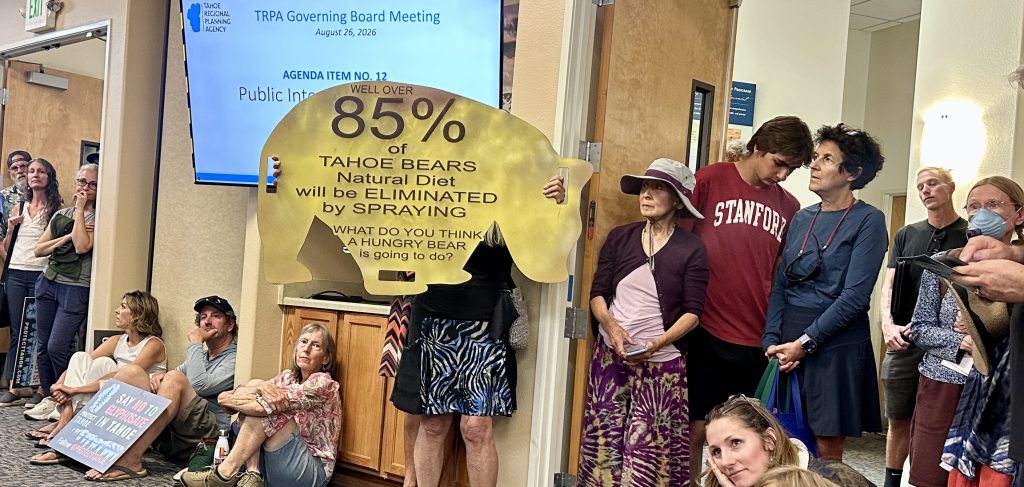
STATELINE, Nev. – During an Environmental Improvement Program (EIP) committee meeting of the Tahoe Regional Planning Agency (TRPA) governing board on August 26, more than a hundred community members rallied – both in person and online – to speak in opposition to the spraying of glyphosate as part of the U.S. Forest Service Lake Tahoe Basin Management Unit’s (LTBMU) Caldor Fire Restoration Project.
The meeting was chaired by Brooke Laine. It was attended by TRPA governing board members and EIP committee members, including Joseph Cannata who was recently appointed to the board by California Governor Gavin Newsom.
In March of this year, LTBMU released an Environmental Assessment (EA) and Decision Notice to move forward with the Caldor Fire Restoration Project which aims to restore ecological processes and habitat conditions and improve resiliency for not only future wildfire impacts, but also drought, disease and insect outbreaks. There are several restoration actions proposed on just shy of 8,000 acres of the Caldor Fire burn scar.
During LTBMU’s presentation to TRPA and according to their EA, there are roughly 4,900 acres where natural forest regeneration is unlikely, and the project proposes strategic reforestation on 2,400 – 3,600 of those acres in 2028. The use of herbicides is considered a potential tactic to achieve this by reducing shrub layers that have out-shaded seedlings.
“We have to put this tool in the toolbox,” said Ashley Sibr, Environmental Coordinator for LTBMU during her presentation. “There’s a lot of feelings about this topic. We know that we’re not going to change how you personally feel about herbicides and their use in the Caldor Fire Restoration Project, but we’re here to help inform you.”
The presentation also touches on “best practices” and states that near waterways, newer techniques would be used, including dipping shears in herbicides and then cutting the stems, “for more targeted treatments over spot spraying.”
Another slide labeled “Resource Protection Measures” states that glyphosate will not be applied between June 1 and September 30 to protect pollinator species, there will be no application before or after rain, buffers will be placed around watercourses and 100 feet of buffer will be placed around milkweed. In addition, application of glyphosate will be through backpack spraying only, with no aerial spraying or aquatic herbicides, and public noticing and signing will be present.
Tensions were high during public comment, and while many public commenters echoed a lot of the same sentiments, their voices varied between anger, passion, and concern.
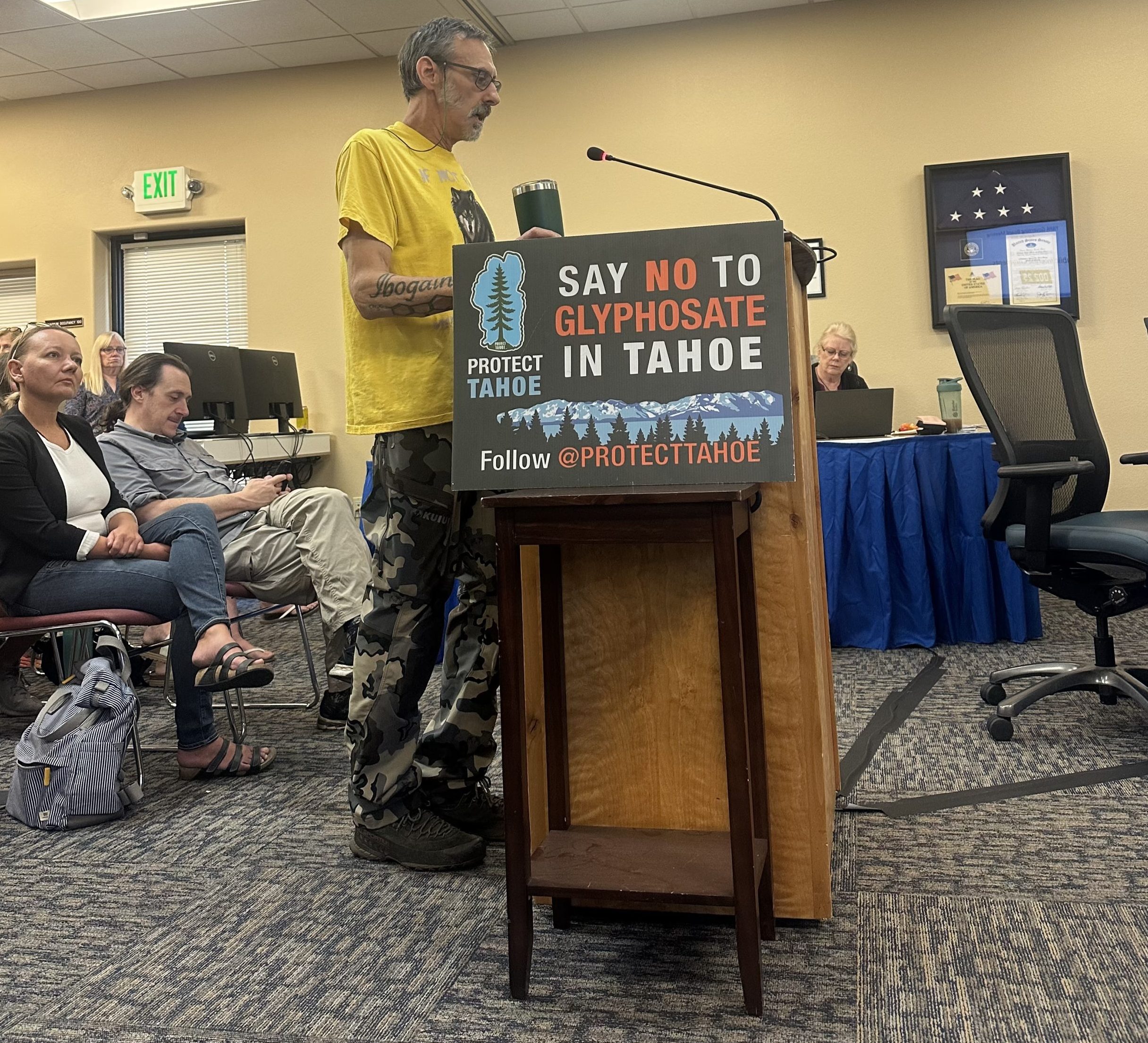
Tara Thornton, cofounder of Protect Tahoe, a campaign which aims to eradicate the use of glyphosate, spoke during public comment of being an expert on the issue of pesticides, policy, legislation and community organizing.
“Our mission to project Tahoe is to make a bi-state, bioregional model of healthy forest regeneration and wildfire mitigation without the use of conventional herbicides,” said Thornton. “Tahoe is the heart and the hub of it. TRPA, you do have the regulatory authority. You’re the only entity in the United States, even beyond the California Coastal Commission that has full authority over every entity, including the U.S. Forest Service.”
Other commenters, including those from members of the Washoe Tribe, voiced concerns related to wildlife and to the herbicide being detected in ambient air and rainwater samples. In addition, topics related to cancer, lawsuits against the chemical company Monsanto, and the health of LTBMU employees who will be wearing backpack sprayers were all prevalent.
Scott Robbins, South Lake Tahoe city councilmember, spoke independently and in a personal capacity during public comment about federal policy over the last two years shifting from environmental indifference to belligerence.
“This is the public’s opportunity to influence a change with the one organization that would potentially make a difference,” Robbins told the Tribune after public comment. “The TRPA does not have a good track record of incorporating public feedback into their decisions. I hope that changes here with this issue. I hope they decide to speak for the trees as the public here has spoken for the trees. No one else will.”
Following the presentation and public comment, Mayor of South Lake Tahoe and TRPA governing board member, Cody Bass, spoke from online about implementing a unique approach to how Tahoe’s forests are managed and urged the committee to take this topic to the full governing board.
“That was some of the most moving public comment I’ve ever experienced in my eight years of service,” Bass said. “I’m here for the will of the people, by the people, and I think we have to pay attention to what the people are really demanding in this situation.”
Following four hours of public commentary and more than five hours of meeting, there were no actions taken or motions made by the TRPA regarding the Caldor Fire Restoration Project. The committee said they plan to learn more about the project and discuss possible alternatives to conventional herbicides prior to 2028’s proposed implementation.