
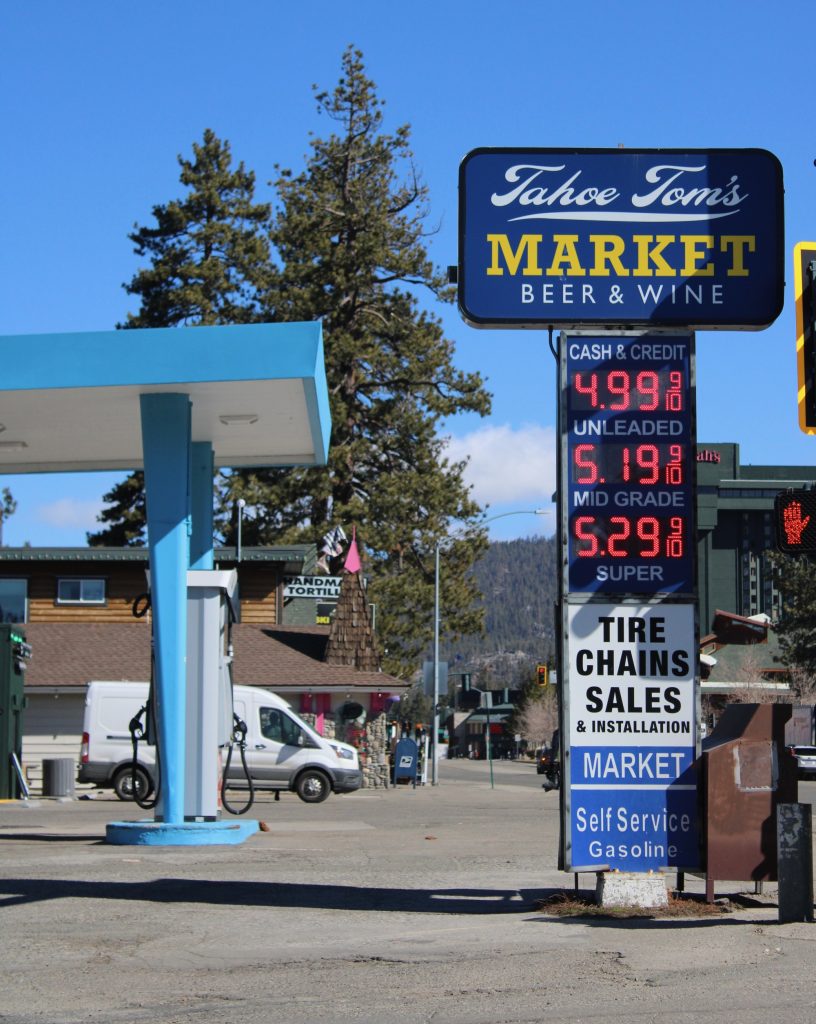
LAKE TAHOE, Calif./Nev. – The national price averages of gasoline continue to rise after the initial attack on Iran, and looming on the horizon are California and Northern Nevada’s annual increased costs due to seasonal shifts. With ‘Operation Epic Fury’ putting a halt on the transportation of oil through the Strait of Hormuz, questions are being raised as to what this means for consumers at the gas pump.
AAA’s weekly fuel report posted on Thursday, February 26 showed California gas prices were down compared to a year ago with the average last year noted at $4.78 a gallon compared to this year’s $4.67. In just one week, their latest fuel report shows the average for a regular gallon of gasoline in California has increased by 18 cents.
“We sent out a gas report on Thursday and on Saturday morning, everything we said went right out the window because the conflict started with Iran,” said Doug Johnson, External Communications Lead at AAA’s Mountain West Group. “This comes at a bad time in California and Northern Nevada because we’re already undergoing a seasonal shift from the winter blend, which is cheaper to produce, into the summer blend which is more expensive.”
The summer blend, which hits gas pumps starting April 1, is higher in price because it’s designed to burn cleaner and prevent fuel evaporation in warmer temperatures, making it more difficult to produce.
In addition to the seasonal price increases, the war overseas is directly impacting the country by hitting the pockets of consumers.
Although the U.S. doesn’t import oil from Iran, both China and India do. “If the Strait of Hormuz, which connects the Persian Gulf to open waters, is blocked, that would send a ripple effect throughout the world, even on countries that don’t heavily rely on oil from the Middle East,” said Johnson. “Iran is a key player in the oil market, and any disruption to its oil infrastructure is consequential.”
Patrick De Haan, GasBuddy’s Head of Petroleum Analysis weighed in on the measures being taken by the president to continue passing through the Strait of Hormuz, such as potential military escorts and government-backed insurance. “The problem is, those don’t directly mitigate the risk. Just because there’s a hurricane coming and I’m insured doesn’t mean I’m going to stay put and build a house out of a hurricane,” De Haan told the Tribune. “There’s inherent risks still that haven’t been addressed.”
According to petroleum oversight experts at California Energy Commission (CEC), geopolitical tension had already set the ball in motion for crude oil to rise. “Consumers are already feeling it at the pump,” said a CEC spokesperson. “We cannot predict how much prices will increase or for how long; that depends on how long this conflict lasts.”
With no end in sight and a limited pool of non-Middle Eastern barrels, refiners from around the world are competing in a demanding market as Middle Eastern barrels reach the mid $70 range per barrel. “The ability to pivot sources will depend on a refinery’s compatibility, shipping, and global pricing, not on state policy.”
As shown in AAA’s gas tracker website, El Dorado and Placer Counties are sitting in the slot of second highest county retail prices in California, with El Dorado County currently slightly higher than Placer. These numbers have been increasing daily with the latest being a 22 cent increase from March 6 to March 8. The average in Nevada has gone up 41 cents in the last week. Washoe County currently shows $4.55 per gallon while Douglas County is priced at $4.15, both categorized highest in county retail prices.
De Haan notes diesel is no exception to price spikes as the country could see the cost of diesel increase by 20 to 40 cents in the next week.
“I would fill up now,” said Johnson. Experts at AAA also provided some tips for saving gas:
- Plan Your Trips: Map fuel-efficient routes using navigation apps to minimize unnecessary turnarounds and backtracking. Combine errands and avoid peak traffic times to reduce drive time.
- Avoid Speeding: Fuel economy peaks at around 50 mph on most cars, then drops off as speeds increase. Driving the recommended speed limit can increase fuel economy between 7 and 14 percent.
- Avoid Excessive Idling: When idling, car engines use up to one-half gallons of fuel per hour. Warm engines take about 10 seconds worth of fuel to restart. Shut off your engine when stopped for more than a minute and if it’s safe to do so.
- Check Tire Pressure and Align Tires: Maintaining proper tire pressure reduces your tire’s friction with the road. Less friction means less energy is needed to move, resulting in using less gas. Proper inflation can improve gas mileage by 0.6 percent on average.
After a pause from 2022 until 2025, many of California’s crude oil imports now come from Saudi Arabia through a pipeline connecting the Persian Gulf to the Red Sea.
“There’s multiple options for California’s refineries; they’re okay for the time being. The real risk is when this starts to really amount to a lot of oil, will the Saudi’s prioritize other refineries higher than the U.S.?” said De Haan. “And that remains an open-ended question.”