LAKE TAHOE, Calif./Nev. – The Trump administration announced Tuesday it will relocate the U.S. Forest Service headquarters from Washington, D.C., to Salt Lake City, marking a sweeping reorganization of one of the nation’s federal land management agencies.
The move is part of a broader overhaul by the U.S. Department of Agriculture that includes closing research facilities in 31 states and restructuring the agency under a new “state-based model.” Instead of its current regional system, the Forest Service would be led by 15 directors overseeing one or more states.
Officials framed the decision as a “common sense” shift aimed at aligning leadership more closely with the lands they manage. The U.S. Forest Service oversees nearly 200 million acres of land, about 90% of which is located in western states.
“Effective stewardship and active management are achieved on the ground, where forests and communities are found — not just behind a desk in the capital,” Forest Service Chief Tom Schultz said.
The change mirrors a similar effort during Trump’s first term, when the Bureau of Land Management was moved from Washington, D.C., to Colorado in 2019. That transition led to significant staff losses, with nearly 90% of Washington-based employees declining to relocate, according to reporting by The Washington Post. The agency’s headquarters was later returned to Washington under the Biden administration.
Conservation groups argue the plan could weaken the agency’s capacity at a time of increasing environmental challenges.
“Simply put, this reorganization will wreak havoc on Forest Service management and organization,” said Josh Hicks, conservation campaigns director at The Wilderness Society.
The Forest Service already has a largely decentralized workforce — roughly 90% of employees are based outside the capital, according to Mountain Journal.
“This administration’s plan to dismantle a 120-year-old agency will mean less access to the public forests people rely on, less capacity to reduce intensifying wildfire risk and more threats to clean air, clean water and wildlife habitat,” said Hicks in a statement.
Although Utah will serve as the agency’s new headquarters, it ranks 11th nationally in national forest coverage, with about 14,300 square miles.
CALIFORNIA AND NEVADA IMPACT
The Forest Service manages vast tracts of public land across the country, including significant holdings in California and Nevada. For example, Tahoe National Forest encompasses more than 850,000 acres of federally managed land. With the reorganization, the two states will see significant changes.
In California, Placerville will serve as the California–Hawaii State Office and will also host an operational service center, while a national training center is planned for Vallejo. However, the reorganization will shutter the state’s Research and Development facilities in Anderson, Fresno, Chico, Fort Bragg, Mt. Shasta and Hat Creek.
Nearby, Reno’s Research and Development facility will also close, with its state operations relocating to Salt Lake City, which will serve as the new Utah–Nevada State Office.
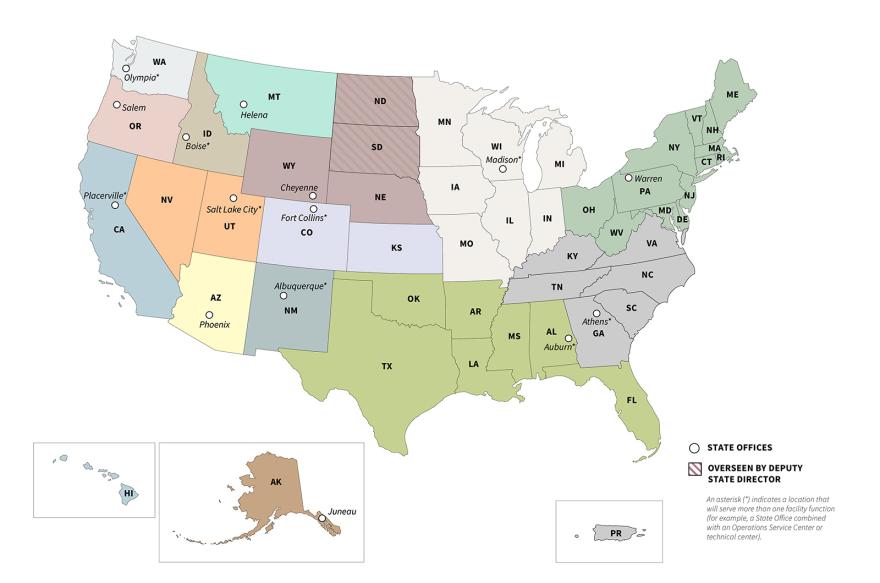
The administration has described the restructuring as a “commonsense approach,” but opponents view it as part of a broader effort to reduce the influence and effectiveness of federal land agencies — raising concerns about long-term impacts on public lands, wildfire management and conservation efforts nationwide.
Agriculture Secretary Brooke Rollins added that the relocation is expected to be completed by summer 2027.