
“Far more money has been lost by investors preparing for corrections, or trying to anticipate corrections, than has been lost in corrections themselves.” — Peter Lynch
Market volatility jumped after the election. Is it still a bull market? Years ago I learned from Lowry Research (www.lowryresearch.com) that the single best indicator of an approaching market top is a negative divergence where the market indexes reach new highs while the majority of stocks are falling.
To measure the activity of most stocks I use an “Advance-Decline Line.” This market-breadth indicator compares the number of advancing stocks on the NYSE to the number of declining stocks. When the AD Line is stronger than the S&P 500 index, it signals broad market participation. When the S&P 500 outperforms the AD Line, however, market breadth is poor, which serves as a warning flag that the risk is increasing.
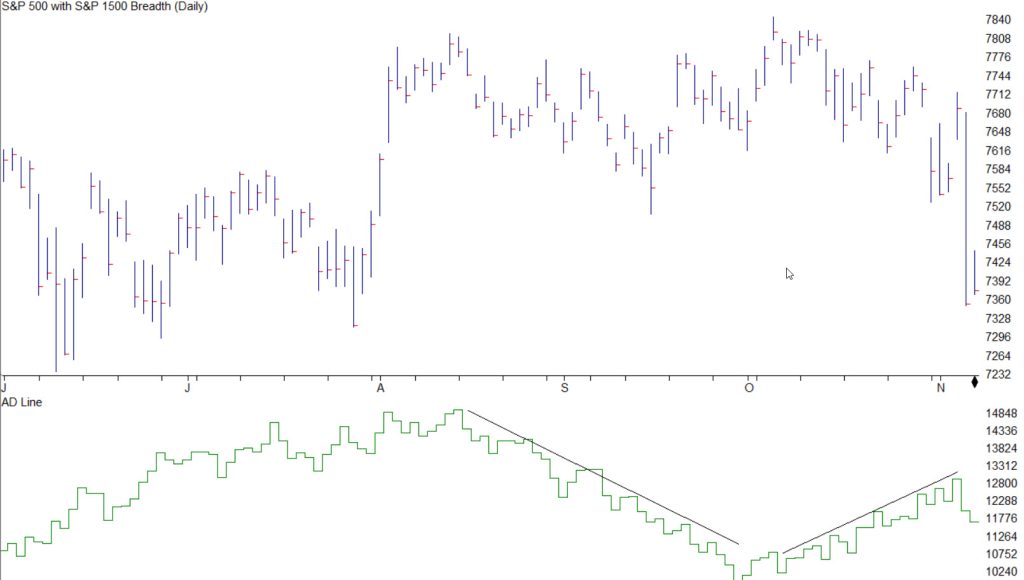
Before most major bear markets there are typically several months where the market indexes reach new highs at the same time that the AD Line trends lower. The longer this divergence persists, the larger the expected market drop. An extreme example came during the dot-com bubble top in 2000. The AD Line fell for two years even as the market reached new highs!
Alternatively, investors can compare the S&P 500 to the Invesco Equal Weight ETF (RSP). A warning flag appears when the S&P 500 is rising at the same time that RSP is falling.
So what are these indicators saying now? My AD Line, calculated based on 1,500 stocks, fell from mid-August to October even as the S&P 500 sat at its highs. That was a warning of a pullback but it’s not nearly a deep enough divergence to signal a true bear market.
Bottom line: There was a negative divergence for a month and a half but the line has risen since then. There is no warning flag of a new bear market. That said, we’ll keep watch.
— David Vomund is an Incline Village-based fee-only money manager. Information is found at www.VomundInvestments.com or by calling 775-832-8555. Clients hold the positions mentioned in this article. Past performance does not guarantee future results. Consult your financial advisor before purchasing any security.