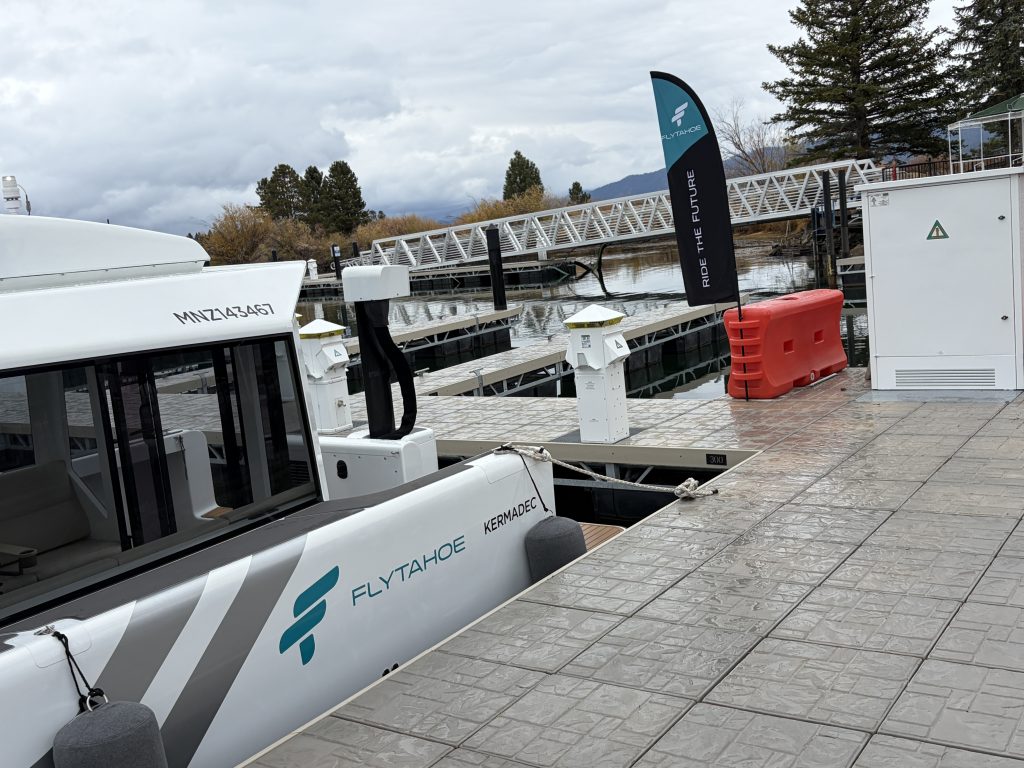
SOUTH LAKE TAHOE, Calif. – Another vital piece of electrical infrastructure needed for FlyTahoe’s mixed fleet of hydrofoil ferries has been installed at the Tahoe Keys Marina in the form of a marine power pedestal designed to support direct-current fast-charging (DCFC) capabilities, making it the first of its kind in South Lake Tahoe.
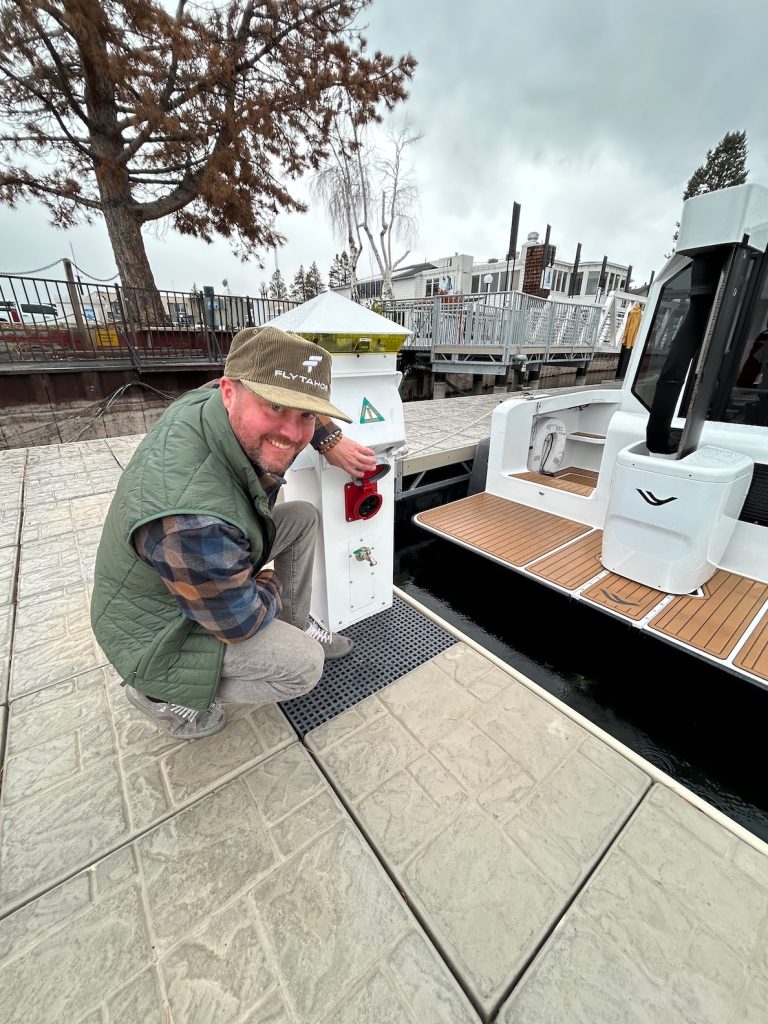
Ryan Meinzer, founder and CEO of FlyTahoe, and his team have been working to develop a sustainable water transit network, partnering with manufacturers Candela and Vessev to operate both 30-passenger and 10-passenger ferries on the waters of Lake Tahoe.
Now, after two years of working with Suntex Marinas, owners of the Tahoe Keys Marina, FlyTahoe has secured the first-ever DC fast charger pedestal in South Lake Tahoe. This marine infrastructure has a 100-amp, 480-volt three-phase supply and is the third charger installed on the lake as part of the marina’s redevelopment project.
The two other chargers are located at Homewood High and Dry Marina on the west shore and Tahoe City Marina on the north shore, both of which were the first-on-the-water electric boat charging stations in the United States.
Meinzer told the Tribune that one of the overarching goals for FlyTahoe is to connect shoreline communities.
“If we’re connecting shoreline communities, what we’re doing is we’re increasing accessibility, inclusivity, and socioeconomic mobility around the entire lake. So there’s no more north-south. We are one.”
South Lake Tahoe’s DC fast charger will not only provide faster vessel turnaround for FlyTahoe’s mixed fleet of both 30-passenger and 10-passenger vessels, it marks a stepping stone for the foundation being built by FlyTahoe to make ferries possible for locals and visitors to utilize.
“It’s just like with an airline,” Meinzer said. “You have different planes for different routes. It’s the same thing. The 30-passenger vessel will be leveraged for the cross-lake [north-south] route.”
In terms of the socioeconomic side of the equation, Meinzer touched on affordability for locals. South Shore offers a large inventory of lower-priced, entry-level homes, duplexes and condos, along with incentives such as South Lake Tahoe’s Long-Term Rental Incentive Program, making it an attractive place to live, in terms of affordability. If South Shore residents were interested in working on the North Shore, FlyTahoe is striving to make getting to work more efficient.
“If there’s a way to get across the lake in 30 minutes with our sustainable water transit network, instead of driving the hour and a half, what this does is it boosts the socioeconomics and has a net benefit to everyone around the lake,” Meinzer said. “But if we’re not doing that responsibly, and in an environmentally-stewardship type of way, then what’s it for?”
The ferries, which are battery-operated and run on hydrofoil technology, align with Lake Tahoe’s environmental standards and have been included as a highlight in the Tahoe Regional Planning Agency’s Connections 2050 Regional Transportation Plan.
Public-private partnerships between FlyTahoe and other lakeside entities have not been announced yet. However, the Tribune is following along and will provide more updates ahead of FlyTahoe’s launch scheduled for 2028.