
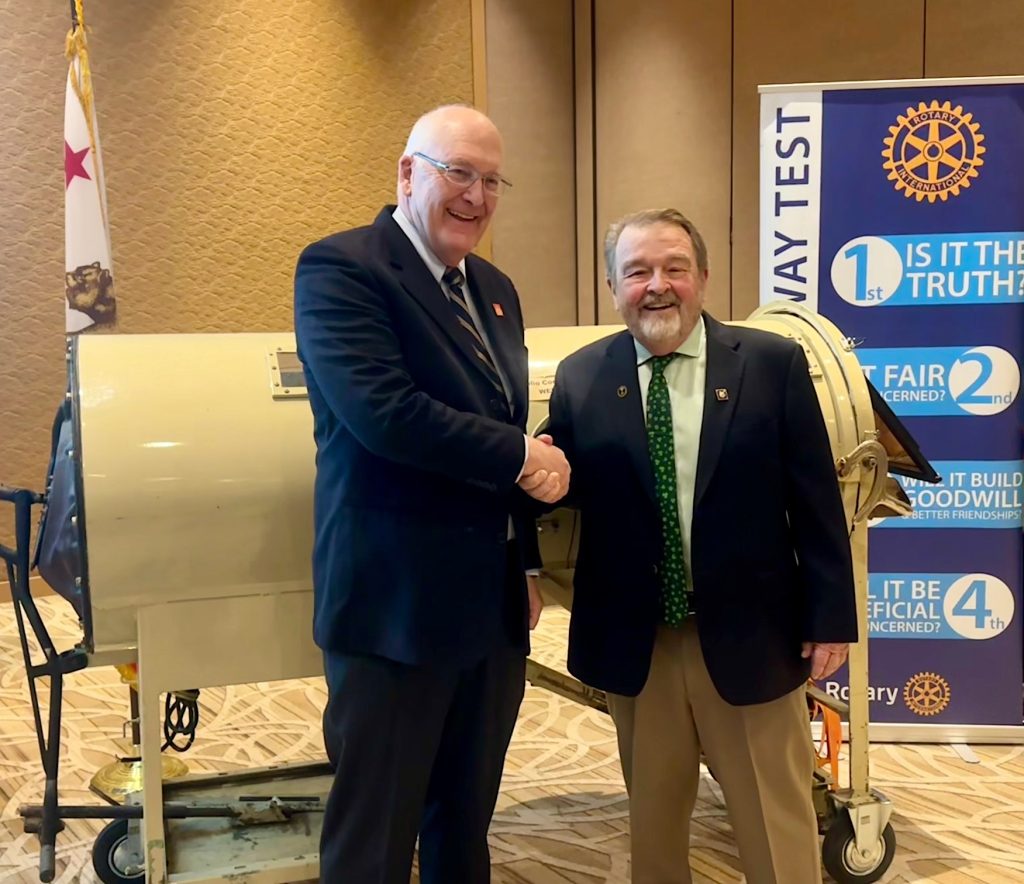
STATELINE, Nev. – Tahoe Douglas and South Lake Tahoe Rotary Clubs joined hands on Tuesday, March 17 to host a presentation centered around their decades-long efforts to eradicate polio disease. In addition to a 1950s iron lung being on display, long-time, nationally recognized Rotarian, David Gallagher, was the keynote speaker. During the event, a fundraiser took place and 50% of proceeds raised were donated to end polio.
Since 1987, Gallagher has been in the Rotary world, serving as President of Modesto Rotary before going on to become Centennial District Governor for District 5220 in 2004. Along with his international humanitarian service, he received Rotary International’s Service Above Self Award, the Rotary Foundation’s Award of Citation for Meritorious Service and the Distinguished Service Award. Gallagher has been a member of the Rotary Club of Reno since 2018 and has traveled all over the world doing Rotary humanitarian projects.
“Somebody asked me to join Rotary,” Gallagher told the Tribune. “I was young, I had a family at home, my business was just starting out and the reason I stayed in Rotary was because it had a softball team. So we had fun! From having fun, we learned more about what Rotary does. The more you put into Rotary the more you’re going to get out of it.”
Bob Fores, President elect of Tahoe Douglas Rotary, has known Gallagher since 1993. Fores was able to obtain an iron lung from his old Rotary district, put it in on a trailer and wheel inside the convention center at Bally’s to be on display. The event was organized to spread awareness about polio, its history, the fight to eradicate it and how that fight has paid off in the last 45 years.
During his keynote speech, Gallagher discussed polio and its history. Caused by a virus that attacks the central nervous system including the neurons essential for muscle control, polio became life-threatening to patients whose respiratory muscles were also affected. The disease primarily infected children under five years old. To this day, there is still no cure, and when annual outbreaks occurred from the 1920s to the 1950s, people were terrified. Schools would close and the only preventative measures that could be taken were quarantines.
Up to the 1980s, there were 125 countries with 350,000 new cases a year. Through immunization, polio numbers have dwindled significantly in the last 40 years. Yet for those who contracted the crippling and highly infectious disease, they had to find ways to ease symptoms. That’s where iron lungs came in.
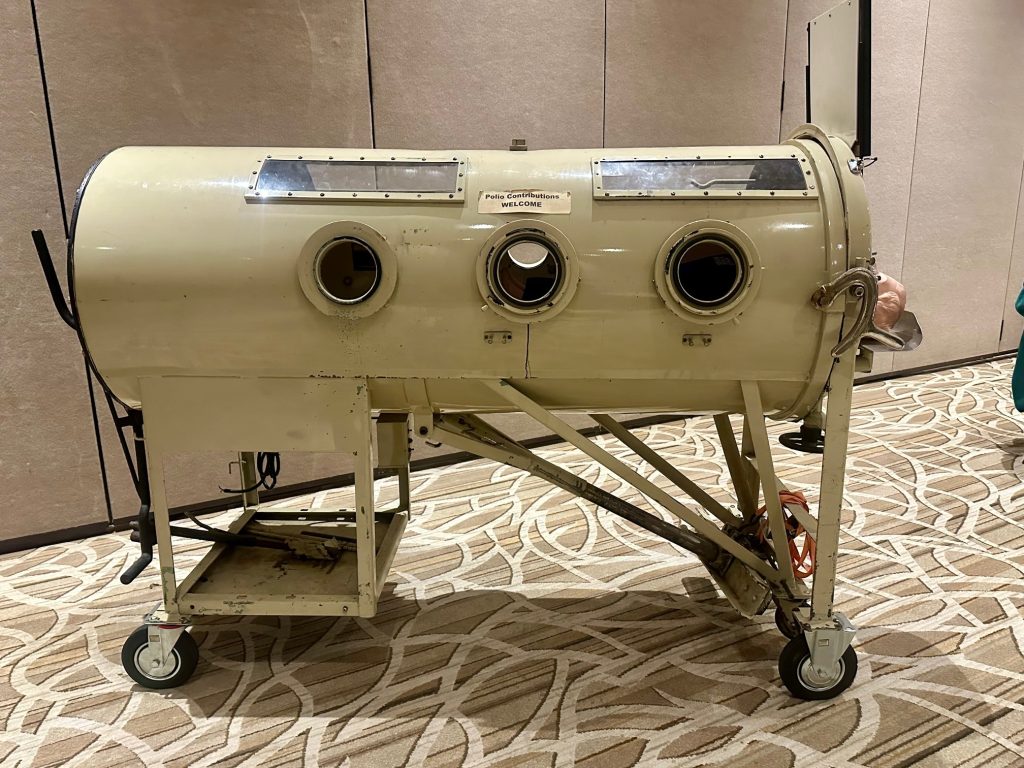
“The iron lungs were just in the large city hospitals. The small hospitals didn’t have the staffing,” Gallagher said. “One out of 120 people who get polio, it affects their limbs – mainly their legs.”
For those who experienced paralysis of the legs, about 5% would get paralysis of the chest, rendering them unable to breathe.
“[The iron lung] does the breathing for them,” said Gallagher as he explained that the machine would act as a pressure ventilator. With only their heads exposed, patients would be sealed inside while the iron lung created changes in air pressure. For inhalation, the pressure was reduced, and for exhalation, it would increase. Unlike respirators that pump air directly into a patient’s airways, the iron lung would expand the chest naturally.
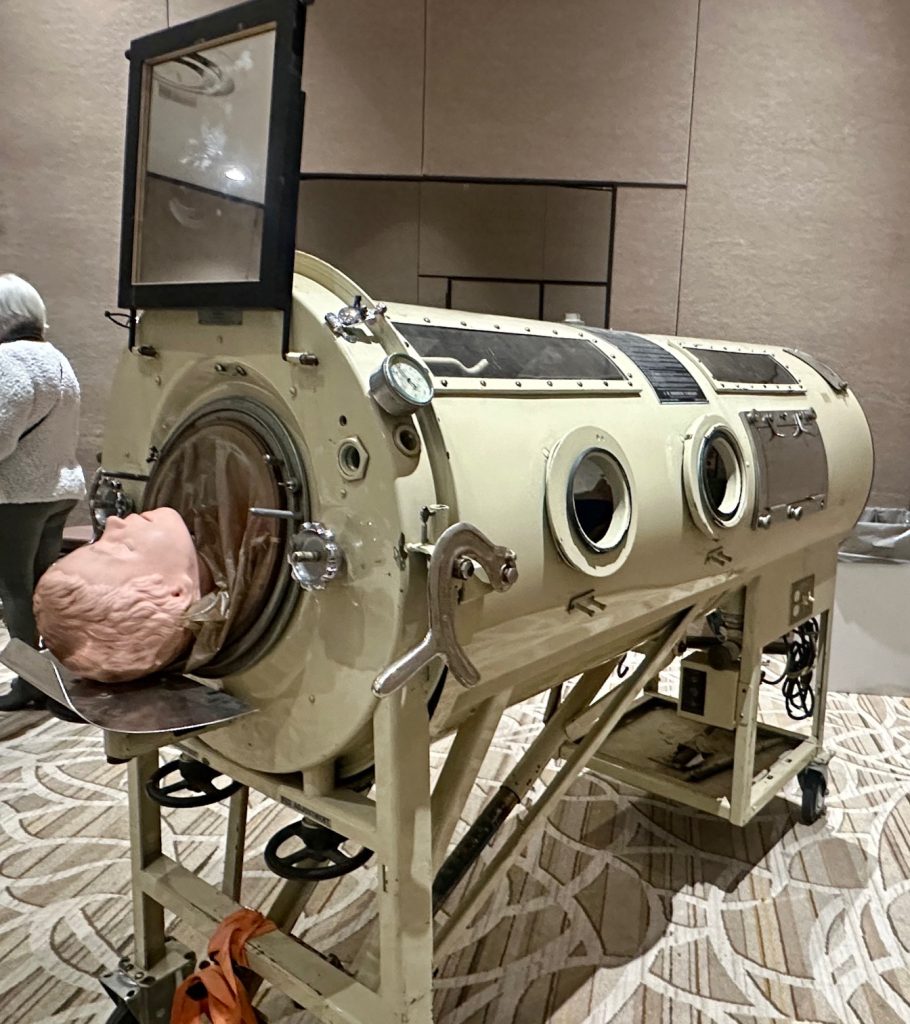
“Certainly, the iron lung is the star tonight, the other part is the importance of vaccines,” added Gallagher. “And how much they work.”
After the U.S. approved the first vaccine in April of 1955, polio cases saw a dramatic drop. In the decade since the vaccine was administered, the U.S. had a near-total elimination of the disease, going from 35,000 to 121. Rotary helped reduce polio cases by over 99.9% since 1979, when the last case was seen in the U.S.
The Global Polio Eradication Initiative (GPEI) was launched in 1988, and was made up of Rotary’s PolioPlus, World Health Organization (WHO), United Nations Children’s Fund (UNICEF), Center for Disease Control (CDC) and supported by the Gates Foundation and Gavi, the Vaccine Alliance. After global mass immunization efforts and more than $2.6 billion in contributions, cases went from 125 countries to its current standing of two countries.
For her community efforts, Gallagher paid special attention to Dr. Rowena Shaw, polio survivor and Tahoe local who worked for the Douglas County School District for 30 years as a psychologist and counselor.
As a child, Dr. Shaw came home with a sore throat. She was not yet vaccinated and was admitted into the hospital with a flu diagnosis. Three days later, she was told she had polio.
“She woke up in the hospital, she saw the iron lung, and said to her mom, ‘Is that my coffin?’ not knowing it would actually save her life,” said Gallagher. “Dr. Shaw turned this into everything positive. She saw the good in people so she went into a helping profession.”
Dr. Shaw had hoped to be in attendance at the evening’s event but was not able to make it due to chemotherapy treatment for leg pains caused by post polio syndrome, a disorder affecting polio survivors and stems from the reactivation of nerves. This process depletes a survivor’s energy and causes muscle weakness and pain.
Although the disease has been eradicated throughout most of the world, maintaining awareness and staying vigilant is a priority. “The people who are driving this whole effort have made very clear that until it’s gone, it’s not gone. We need to drive this to zero and keep it at zero for three years running for them to be convinced that it really isn’t going to come back,” said Greg Felton, treasurer of Tahoe Douglas Rotary.
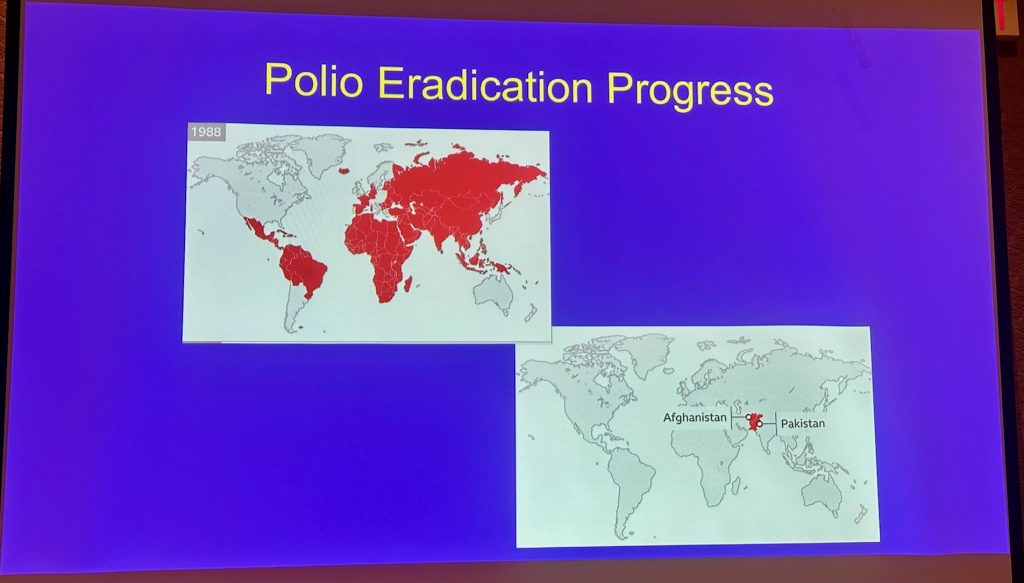
“All of us working together on the same goal, we’ve come this far. They’ve set out a special action plan for 2026, and they’re hoping they can do it. This is going to be a very, very important year,” said Gallagher.
Tahoe Douglas Rotary has some exciting things in store as they announced plans to reanimate their St. Patrick’s Day Spring Fling Fundraiser. The fundraiser, throughout its 50 years, would often draw in hundreds of people, raising upwards of $350,000 before it took a six year pause due to the start of COVID-19. The St. Patrick’s Day Spring Fling Fundraiser is set to take place next year on March 13. More details to follow.