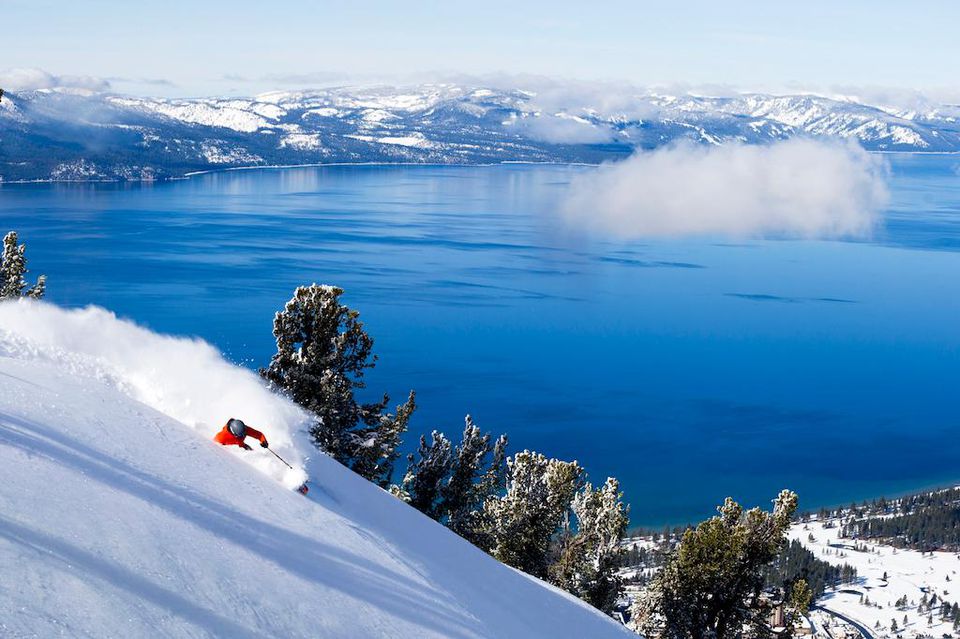
SOUTH LAKE TAHOE, Calif. – After a flurry of snow in February melted away for a mostly warm March, Tahoe’s snowpack is lower than usual this year, though it’s at relatively normal precipitation levels for the year. Despite a small cold front passing through in early April, it’s shaping up to be a potentially drier summer with higher fire risks.
Having a long-lasting snowpack is key for ensuring consistent water access throughout the year. As it melts, it provides water through some of the driest months of the year. The Sierra Nevada’s snowpack supplies roughly 30% of water throughout California, and while rainfall to date is currently at 104% of the average precipitation, earlier melting snowpacks can lead to different issues.
Regional scientist at the Sierra Nevada Conservancy Sarah Campe said, “Researchers are still learning the nuances around low precipitation years and snowpack, but we know precipitation may run off if the snow doesn’t stick.”
Campe went on, “When the snow melts too soon, sometimes it can lead to potential flooding, especially if there is a high snowpack. However, this year, there are more concerns around dryness and potential drought, as well as higher fire risk.”
These more variable years of snow and precipitation are primarily driven by climate change, says Tom Krabacher, professor of geography and climate at Sacramento State. “What happened this year was very exceptional,” he said.
“The rainy season started earlier than usual, but there was not a lot of precipitation since January—followed by an unprecedented warm spell in February and March that was well above anything we’ve really seen at this time of year,” continued Krabacher.
While reservoirs are still at capacity through the rest of the state, the weather variations may certainly impact wildlife, who rely on light and temperature patterns to regulate their lives. But throughout the West, Krabacher says there’s been dryness and drought, in part due to these major weather shifts.
Precipitation across the West is typically coming from a western direction, from the Gulf of Alaska, off of British Columbia and the Pacific Northwest. But it’s been disrupted by ridges—characterized by dry weather, clear skies and high pressure. This persistent ridge has been termed the “Ridiculously Resilient Ridge”, when similar weather patterns were observed in 2012 to 2015.
Right now, warm oceanic temperatures and higher rainfall earlier in the jet stream are strengthening the ridge. While a small trough is expected to travel through this week, bringing some snow and a cooler stretch of weather, Krabacher said it’s unlikely to last.
Warmer patches of weather also cause precipitation to fall as rain rather than snow. And like in February, if ground temperatures are fairly warm, the snow may not even stick around, melting before much else happens.
Up in the mountains, land restoration is a big part of trying to conserve hydrologic patterns. For example, recent research in the Cascades shows that tree treatments may both increase fire resilience and help snowpack stick around longer.
Meadows also serve as “hydrologic lynchpins” according to Campe, as they help control the flow of water through an area, slowing release into the environment for the warmer months, when less rainfall occurs.
Without snow sticking around, forests are likely to become drier, increasing the vulnerability to pests, drought stress and fires. “The bottom line is it’s worrisome to have low snowpack and a warm winter,” said Campe.
However, Campe and Krabacher agree that the work on the ground is key to addressing these concerns. While humans can’t alter major weather patterns, the way we respond to them can produce more resiliency for our environment.
“There is a concern around unpredictability among climatologists. Although we may not be able to predict far into the future, we still feel the effects,” said Krabacher. “There is a likely effect of drought that the Department of Water Resources is looking at scenarios for. What is becoming important is the response on the ground and preparations for increasingly dry conditions.”
For example, the Sierra Nevada Conservancy is helping to fund landscape conservation across multiple organizations, along with investing in work for avoiding catastrophes. “Our best bet is to create healthy ecosystems to withstand stressors,” said Campe. “This type of work to protect communities is necessary in both unusual and ‘normal’ years as we see the impacts of climate change unfold.”
“What goes on in the mountains is important down here, especially as areas of California get a greater and greater percentage of water from the snowpack,” said Krabacher. “We’ve got a vested interest in what is happening up there because it affects us.”