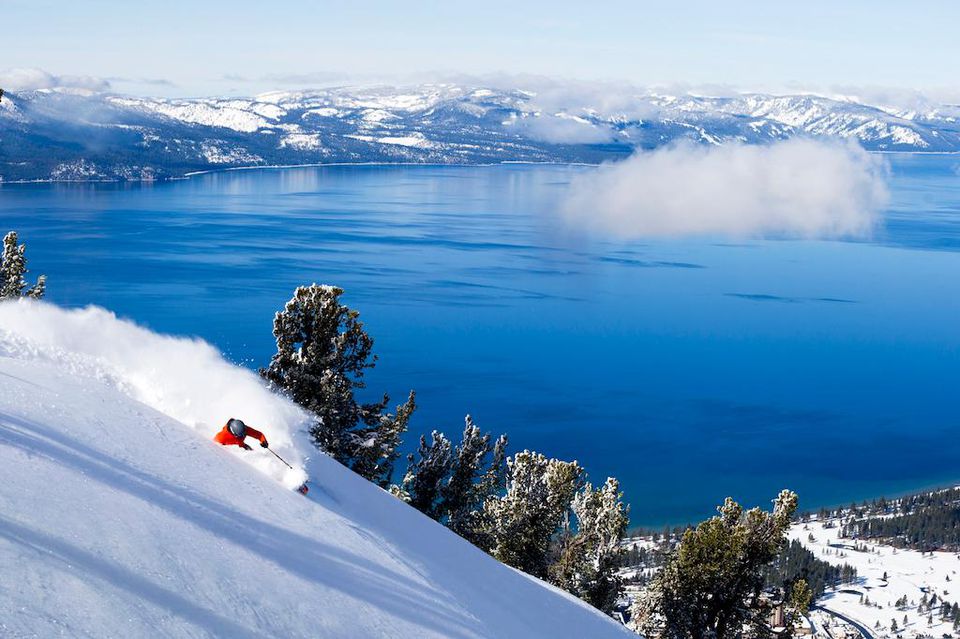
LAKE TAHOE, Calif./Nev. – Plenty of different politicians represent the Lake Tahoe area: straddling two different states, with five counties and overlapping jurisdictions. On the congressional level, Tahoe is represented by Representatives Kevin Kiley and Senators Alex Padilla, Adam Schiff, Catherine Cortez Masto and Jacky Rosen. They’ve each provided millions of dollars and introduced different acts to protect the lake. But who’s responsible for what?
Acts to protect Lake Tahoe
Both the Lake Tahoe Restoration (LTRA) Act and the Santini-Burton Act of 1980 were created to preserve Lake Tahoe.
The original LTRA passed in 2000 and pledged $300 million to restore the lake. After a reauthorization in 2016, it was again reauthorized through the efforts of Sens. Cortez Masto, Rosen, Padilla and Rep. Kiley. It officially passed in September 2024 and extends the time for appropriating the funds to 2034.
The Santini-Burton Act authorized the sale of federal land in Clark County to fund the acquisition and management of environmentally sensitive land, totaling over 16,000 acres. However, another act unintentionally limited the funds generated by Santini-Burton to acquisitions and not management.
The Santini-Burton Modernization Act would allow the U.S. Forest Service to use the funds to manage public lands, and would expand the authority of the Washoe Tribe to manage lands. It was introduced to the Senate in late January by Cortez Masto, Rosen and Padilla, while companion legislation was introduced in the House by Kiley. Most recently, the act was heard in the Senate in mid-February.
In January 2025, the EXPLORE Act passed as law. Schiff, Padilla, Cortez Masto and Rosen requested the Department of Agriculture and Department of the Interior to ensure the Tahoe Basin would benefit from it, such as requests to select bike trails for designation, account for housing and municipal infrastructure, lease USFS land for housing and affirm Tahoe’s qualification as a participant in the Outdoor Recreation Legacy Partnership program.
Other bills introduced this year into Congress regarding Tahoe are Rosen’s Truckee Meadows Public Land Management Act and the Save our Sequoias Act introduced by both Sen. Padilla and Rep. Kiley.
Funding for Tahoe
Key funding for projects typically comes from grants or laws like the Bipartisan Infrastructure Law. In 2025, that law, which Cortez Masto and Rosen both voted to pass, was utilized to generate $3.1 million to prevent the spread of aquatic invasive species in Tahoe.
In September 2025, Rosen also announced that she had secured over $4 million in wildfire prevention in Nevada. From the Bipartisan Infrastructure Law’s Community Wildfire Defense Grant program, the funding was for creating defensible space in Lake Tahoe.
Schiff at one point had earmarked approximately $1 million for replacing the LeConte, a research vessel at the Tahoe Environmental Research Center, though it ultimately did not materialize. It’s possible that Schiff may work with UC Davis to request that money again this year.
Recent federal grants pushed for by Padilla and Schiff were also supported by Kiley.
In Nevada’s 2026 fiscal year, Cortez Masto and Rosen secured over $49 million for community project funding, with Rosen allocating $20.1 million to support preservation, firefighting and additional projects in Tahoe.
The recent $1.2 million for 3900 Lake Tahoe Boulevard’s apartments and $1 million for the South Tahoe Public Utilities Department project on Park were appropriated through community project funding and congressionally directed spending. Schiff and Kiley were responsible for requesting these funds as part of Senate and House committees, though it originated in the House.
Kiley also originated the request for $1.14 million for the Tahoe City Public Utility District improvement at Madden Creek’s Water System, supported by Padilla. Padilla also supported funding for a ladder truck for Bishop, along with emergency backup generators and emergency facility renovation for Mono County
Cortez Masto and Rosen both requested $5 million for the Tahoe Transportation District and Sand Harbor Multi-Use Trail Project.