LAKE TAHOE, Calif. – With fewer than 50 known individuals in California, spotting a Sierra Nevada Red Fox is a lot like finding a needle in a haystack.
That’s why the folks at Pathways for Wildlife (PFW) were so surprised to see one while reviewing November footage from their wildlife cameras—but certain features were hard to deny.
“They’re super fluffy because they exist at such high elevations,” Tanya Diamond, Wildlife Ecologist and GIS Analyst at PFW, explained, endearingly adding, “they are constantly in their puffers.”
These foxes also have telling tracks. Having fluffier feet than gray foxes, what Diamond calls “ski mode,” this distinction is reflected in their paw prints.
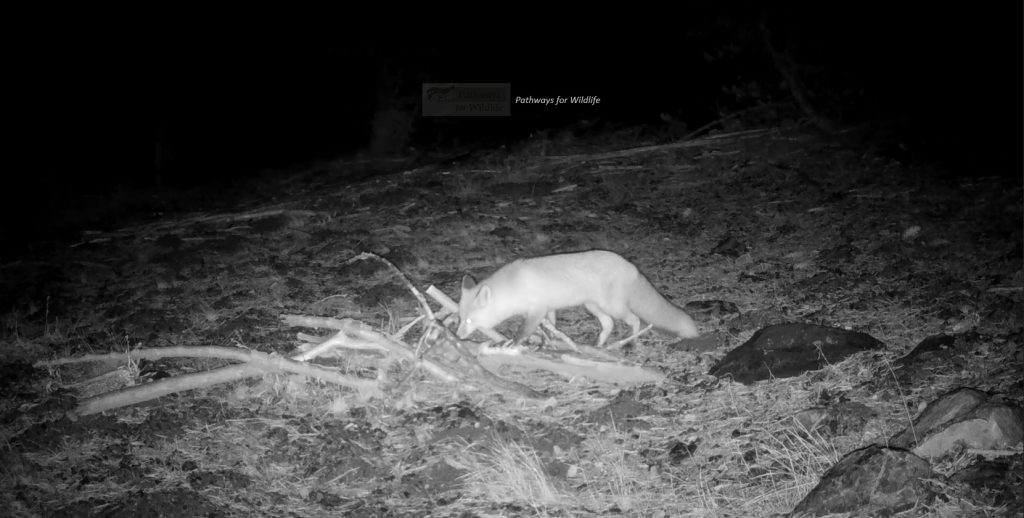
Diamond and her partner, Ahíga Sandoval, have teamed up with and are funded by the California Tahoe Conservancy to conduct surveys for potential wildlife road crossings in the Tahoe Basin. They also identify important habitat linkages in landscapes, using wildlife cameras, which is how they found the fox.
Diamond and Sandoval are working closely with the U.S. Forest Service, which is part of a statewide Sierra Nevada Red Fox working group focused on conservation efforts for the species.
PFW’s video capture near Blackwood Canyon makes it the first record of a Sierra Nevada Red Fox documented in the Tahoe West Basin.
The Sierra Nevada Red Fox is one of California’s rarest and most elusive native carnivores, found only in the Sierra Nevada. The species is listed as threatened under the California Endangered Species Act. At the federal level, they’re considered endangered.
“They’re hanging by a thread,” Diamond said.
It isn’t entirely known why their population has declined so much. California Department of Fish and Wildlife (CDFW) believes unregulated hunting and trapping in the early 20th century could have been factors. What is known is that the species continues to suffer from low genetic diversity, which can exacerbate its already struggling condition.
A study published in 2019 by Benjamin N Sacks and colleagues at UC Davis offered a glimmer of hope in finding that migrating red foxes from the Great Basin Desert had improved the genetics of one Sierra Nevada Red Fox population, at least for the short term.
PFW’s recording could be a promising indicator for the species. Diamond feels this sighting is a sign that land protection, conservation and connectivity work are paying off.
“I think these animals are actually being able to disperse and move and establish new home ranges,” she said.
Around the same time PFW made its discovery, CDFW captured a Sierra Nevada Red Fox near Mammoth Lakes. Biologists fitted the fox with a GPS-tracking collar and released it.
It’s a noteworthy event, considering the species’ cautious nature, low numbers, and remote locations.
The intel from this tracked fox, along with insights from PFW’s recording, will provide vital information to help conserve the sensitive species in the future.