River Otters: Larger than thought, feistier than expected, and definitely in Lake Tahoe
When you think of a badger or a wolverine, you probably picture a fierce, powerful predator and you’d be right. These tough mammals are part of the family Mustelidae, the weasels, and can occasionally be found in Tahoe alongside several other members of the weasel family. The longest of them all, with some adults reaching four feet in length, is the River Otter, which has certainly been making headlines lately.
The Tahoe region is home, at least occasionally, to seven species of mustelids, including not only the aforementioned North American River Otter, American Badger, and Wolverine but also their cousins, the Long-tailed Weasel, American Short-tailed Weasel, American Mink, and Pacific Marten. Some of these animals can look quite similar, while others appear very different from one another, but they all share characteristics typical of the family: elongated bodies, relatively short legs, small rounded ears, short skulls, and dense fur. Depending on the species, mustelids can be terrestrial, arboreal, or aquatic, with river otters and mink particularly well adapted to life in and around water.
Will Richardson, Executive Director at the Tahoe Institute for Natural Science (TINS), is not surprised that so few Tahoe residents know that we have otters here: “We have been closely tracking the dramatic return of river otters to the area over the last 15 or so years, both through staff observations along the Truckee River and around Donner and Lake Tahoe, as well as through photographs and reports shared with us by members of the community.”
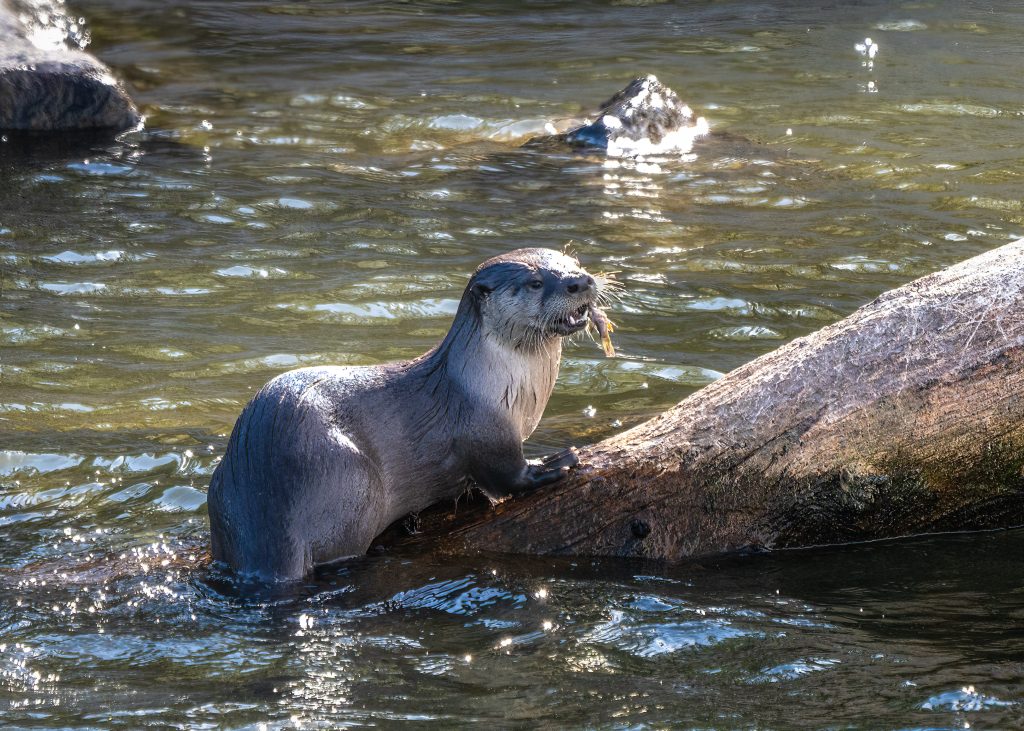
“They are not new invaders to Tahoe, but they were largely absent from the region for many decades, having been trapped out from most of the watershed,” Richardson said. “And for a lot of folks, it can be a little tricky telling them apart from a Mink. Nevertheless, they are a natural part of the region’s wildlife community and are well adapted to living in and around our cold, high-elevation waterways, and seem to be thriving as they repopulate the area.”
In summary, river otters inhabit Tahoe and belong here.
The Otter Incident: Rare but Real
Recently, a swimmer in Lake Tahoe was bitten and injured by a North American River Otter during an open-water swim. The encounter was certainly surprising and understandably generated a lot of attention.
As someone who teaches people about Tahoe’s wildlife, I was surprised by the encounter, but I was also not surprised that an otter, related to other fierce weasels could behave this way. River otters are extremely effective predators, and their bodies are built for hunting in the water, with webbed feet, powerful tails, dense waterproof fur, and strong jaws. Their playful and curious behavior can make them fun to watch, but it is important to always remember that they are wild animals.
We also should not assume we know exactly why this particular otter attacked the swimmer. Without knowing the circumstances from the animal’s perspective, it would be difficult to speculate about its motivation. What we do know is that wild animals can react defensively when they feel threatened, surprised, cornered, or otherwise disturbed, especially with a pup nearby. The best way to avoid a negative wildlife encounter is to give animals plenty of space and allow them a way to move away from us.
Is this attack common? Short answer, no. Did it happen? Yes. Could it happen again? Potentially. It is not unprecedented in the region. In 2023, river otters attacked multiple people in Serene Lakes, near Donner Summit.
I think the bigger lesson is not that people should be afraid of swimming in Lake Tahoe but be aware that we live in a place where people and wildlife share the same landscape. When we hike, swim, paddle, camp, ski, or explore around Lake Tahoe, we are recreating in wildlife habitat. We cannot control what wild animals do and occasionally we may encounter them in unexpected places. That is part of living in a wild landscape alongside other predators that call Tahoe home, including bears, mountain lions, and, increasingly heading our way, wolves.
Does that mean the swimmer should have known this could happen? Absolutely not.
This was an unlucky and unusual encounter, and there is no reason to suggest that she should have expected it, especially in an open-water swimming context, and we feel terrible that it happened. But it does give all of us a good reminder about how to interact with wildlife. Watch them. Photograph them. Learn about them. Enjoy seeing them but most importantly, give them space.
Cute but NOT Cuddly
It is unfortunate that an unusual encounter can overshadow all of the amazing things we know about these animals. River otters are fascinating members of Tahoe’s ecosystem.
They are excellent swimmers and can remain underwater for several minutes at a time. Their dense fur helps insulate them in cold water, and they are active year-round. They can even use snow and ice to their advantage, moving across frozen surfaces by sliding on their bellies and bounding.
Their diet is largely aquatic, with fish and crayfish among their favorite foods. Will Richardson recently shared with me how their intelligence and adaptability has led them to take advantage of novel prey at Point Reyes National Seashore, where they have learned how to drown Brown Pelicans as they swim in the estuaries.
As predators, they play an important role in the streams, rivers, and lakes wherever they live. They are capable of traveling on land by walking, running, or sliding and can move between
tributaries and watersheds in search of food and suitable habitat. And if you have ever seen river otters playing, swimming, feeding, grooming, or sunning themselves along the water, you know just how fun they can be to watch.
Wild animals deserve the opportunity to remain wild, and the best wildlife encounter is one where both you and the animal get to walk, swim, or slide away safely.
Enjoy articles like this? Consider supporting TINS, your local research nonprofit dedicated to understanding Tahoe’s wildlife and educating the community about the natural world around us. www.tinsweb.org.